Railway logistics of the BRICS countries
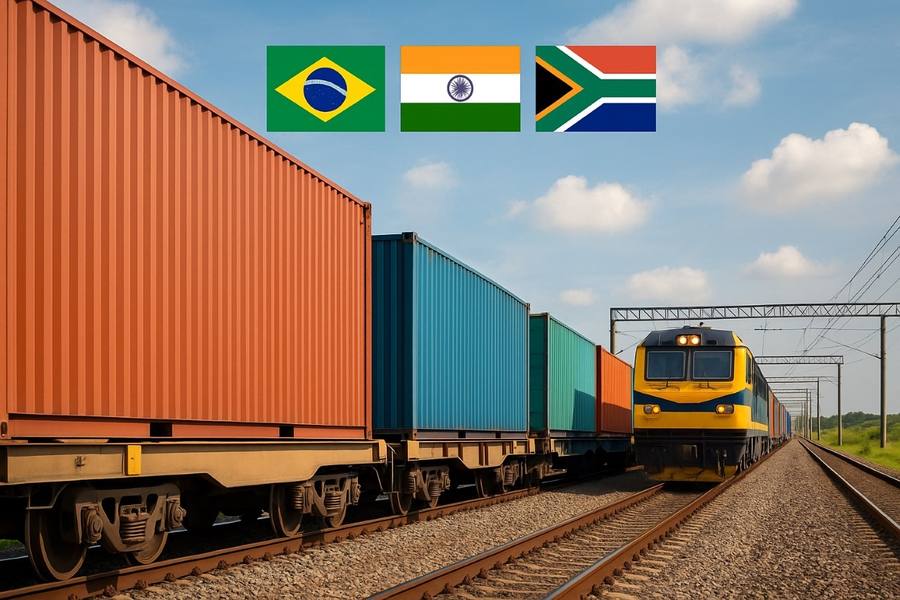
The railway infrastructure of the BRICS countries (Brazil, India, South Africa) plays an important role in servicing domestic freight traffic and international trade. Despite differences in standards, length and modernization of networks, these countries are actively developing logistics in conjunction with ports, industrial centers and strategic corridors.
India
Main routes and corridors
- The Golden Quadrilateral connects New Delhi, Mumbai, Chennai and Calcutta.
- Dedicated Freight Corridors (DFC):
Western DFC – from Delhi to Mumbai, a key route for container shipping.
Eastern DFC - from Ludhiana to Dancuni, focused on the transportation of coal, steel and industrial products.
The largest railway terminals
- Dadri ICD (Uttar Pradesh) is one of the largest intermodal terminals in India.
- Tughlakabad ICD (Delhi) is a highly automated hub with access to ports.
- Mundra Port Rail Terminal is connected to the largest private port in the country.
Connection with ports and industrial zones
- Direct connection of terminals to the ports of Mundra, Nhava Sheva and Chennai.
- Corridors pass through Special Economic Zones (SEZ): Gujarat SEZ, Noida SEZ, Kandla SEZ.
Features
- A wide track (1676 mm) is used.
- Electrification of over 80% of routes.
- The huge domestic market stimulates the growth of cargo transportation.
South Africa
Main routes and corridors
- Maputo Corridor connects Johannesburg with the port of Maputo in Mozambique.
- Durban-Gauteng Corridor – from Johannesburg to the port of Durban, a key container port.
- Cape Corridor – from Cape Town via Kimberley to the eastern regions.
The largest railway terminals
- City Deep ICD is the largest intermodal terminal in southern Africa.
- Durban Port Rail Terminal is a port terminal for containers.
- Pretoria Rail Terminal is a center for the redistribution of goods from / to the north of the country.
Connection with ports and industrial zones
- All key corridors provide connections to the ports of Durban, Cape Town and Port Elizabeth.
- Integration with industrial parks in Gauteng and Eastern Cape provinces.
Features
- A narrow track (1067 mm) is used, which limits speed and dimensions.
- It is operated by Transnet Freight Rail.
- A high proportion of bulk cargoes (ore, coal, ferroalloys).
Brazil
Main routes and corridors
- North-South Railway (Ferrovia Norte-Sul) is a strategic route from the north (Tocantins) to the south (Sao Paulo, Paraná).
- Centro-Atlântica Railway connects the country's centers with Atlantic ports.
- Carajás Railway is a specialized line for the export of iron ore.
The largest railway terminals
- Itaqui Rail Terminal - export of bauxite, aluminum, grain.
- Pederneiras Terminal (Sao Paulo) is a logistics hub of the agro-industrial belt.
- Rondonópolis Terminal (Mato Grosso) is an agricultural collection center.
Connection with ports and industrial zones
- The railways are integrated with the ports of Santos, Ithaca and Vitoria.
- Connection with agro-industrial clusters of Central Brazil and the state of Pará.
Features
- Mixed track types (narrow, standard, wide) are used, which complicates interoperability.
- Priority for transportation of agricultural products and ore.
- Private investment in the network is expected to increase.
Development prospects
- India continues to develop rail freight corridors. The main priority is the completion of the western and eastern Dedicated Freight Corridors, the digitalization of logistics and improved port connectivity. New logistics hubs are being actively formed near key industrial zones.
- South Africa is betting on infrastructure modernization and partial privatization. Among the priority projects are the expansion of the City Deep terminal, updating the tracks and attracting private operators to local routes. Attention is paid to improving the capacity and reliability of the network.
- Brazil is focused on improving track compatibility, developing logistics for agro-exports and increasing private investment in rail transport. Strategic projects include the expansion of the North-South Railway and the strengthening of logistics in the agricultural regions of Central Brazil.
The railway logistics of the BRICS countries is showing steady growth, especially against the background of growing exports of raw materials and agricultural products. India is actively building specialized freight corridors, South Africa is strengthening links with ports, and Brazil is developing agrologistics and modernizing north-south railway arteries. Despite technical and infrastructural constraints, all three countries have a systematic approach to developing rail logistics with a focus on intermodality and export efficiency.