Forms of conclusion of foreign trade export contract

The foreign trade contract is the main instrument regulating international commercial relations between companies and their foreign partners. Depending on the manner of conclusion and the legal basis used, the contract may be in written or electronic form. Let’s look at the various forms of contracts, including the requirements of the Civil Code of the Russian Federation, the features of the electronic form and international regulation concerning electronic signature.
Rules on the form of the transaction: Civil Code of the Russian Federation, Article 1209
The Civil Code of the Russian Federation regulates the rules for concluding transactions, including foreign trade, and determines the form that must be observed when signing a contract. Article 1209 of the Civil Code of the Russian Federation specifies the following basic provisions:
- General rule: The form of the transaction is determined by the law of the country that governs the transaction itself. This means that for an international contract, the form of the transaction will be subject to the law of the country chosen by the parties for application.
- Invalidity of transaction: The transaction cannot be recognized as invalid only because of non-compliance with the form, if the requirements of the law of the country of its conclusion were met. If the contract is concluded abroad, its form is subject to foreign law.
- A transaction involving a Russian person: if at least one of the parties is a person subject to Russian law, the transaction will not be invalidated due to non-compliance with the form, if the requirements of Russian law are met.
Place of transaction
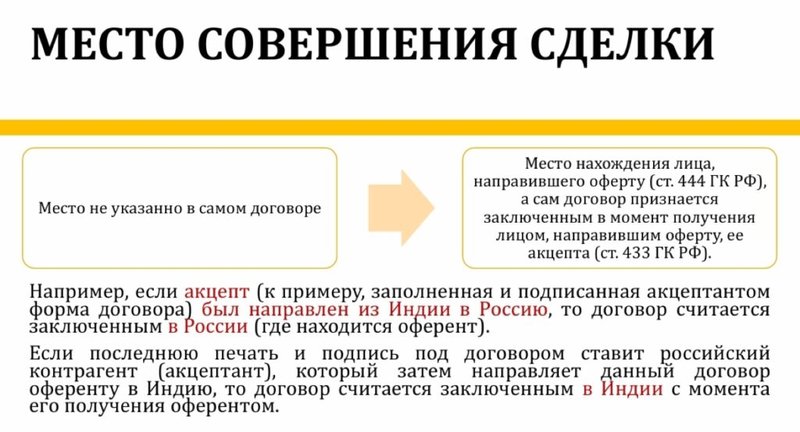
The location of a foreign trade contract is also important, especially if the parties are in different jurisdictions. The place of conclusion of the transaction can be considered:
- Place specified in the contract: If the contract specifies a specific place (e.g. “Istanbul”), the contract is deemed to have been concluded at the specified place, even if the actual signing took place elsewhere.
- Location of the offeror: If the contract does not specify a specific place, the place of conclusion of the transaction is defined as the place where the person who sent the offer is located. The contract is considered concluded at the time of receipt of acceptance by the offeror.
Written form of contract conclusion
According to paragraph 2 of Article 434 of the Civil Code of the Russian Federation, a foreign trade contract may be concluded in writing in several ways:
- Drafting of a single document: This is the most common way for the parties to sign a common document.
- Exchange of documents: exchange of letters, telegrams, faxes or electronic messages that can reliably confirm that the documents come from the parties to the contract.
- Actions confirming acceptance: If the party receiving the offer commences performance of the terms of the contract, such as shipping goods or making payment, this may also be considered acceptance unless otherwise stated in the terms of the offer.
Electronic form of contract
In modern conditions, electronic form is increasingly used for concluding contracts. The legislation of the Russian Federation recognizes the legal force of an electronic document provided that it is signed with an electronic signature, according to the Federal Law "On Electronic Signature" dated 06.04.2011. Electronic signatures are of the following types:
- Simple electronic signature (EEP): Identifies the signatory but does not have enhanced protection.
- Enhanced non-qualified electronic signature: a more secure type of signature, but does not require accreditation.
- Enhanced Qualified Electronic Signature: The most secure type of signature requiring accreditation is equivalent to a handwritten signature.
Position of international law
Many countries recognize electronic signatures only if they meet certain cryptographic requirements. In some cases, if an electronic signature does not meet international standards, its legal significance may be challenged.
United Nations Convention on the Use of Electronic Communications in International Contracts
In 2005, UNCITRAL adopted the UN Convention on the Use of Electronic Communications in International Contracts, which entered into force in 2013. Russia has signed the Convention, but has set a number of restrictions:
- The Convention applies only to international contracts if the parties have agreed to its application.
- The Convention does not regulate transactions for which a notarial form or state registration is required, as well as transactions related to goods whose movement across the customs border is prohibited or restricted.
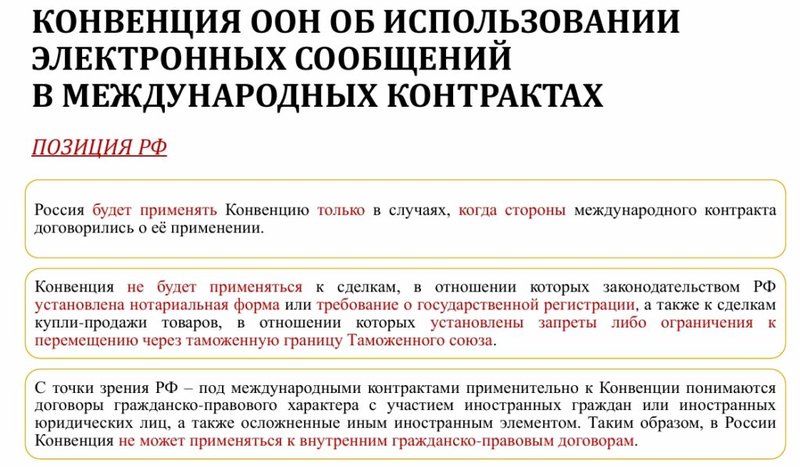
The Convention also excludes the application to electronic communications relating to stock market transactions, foreign exchange transactions, interbank payment systems and other similar agreements.
When concluding foreign trade contracts, it is important to take into account the legal requirements for the form of the transaction, whether written or electronic. Electronic contracts are becoming increasingly popular, but for their legal significance it is important that signatures are executed in accordance with the requirements of both Russian and international law.
Experts from EXPORTDINST LLC will be happy to advise you on all issues related to the foreign trade export contract. We are happy to share their contacts with you in related companies.