Certification through Kazakhstan and Kyrgyzstan: working scheme or risk in 2026?
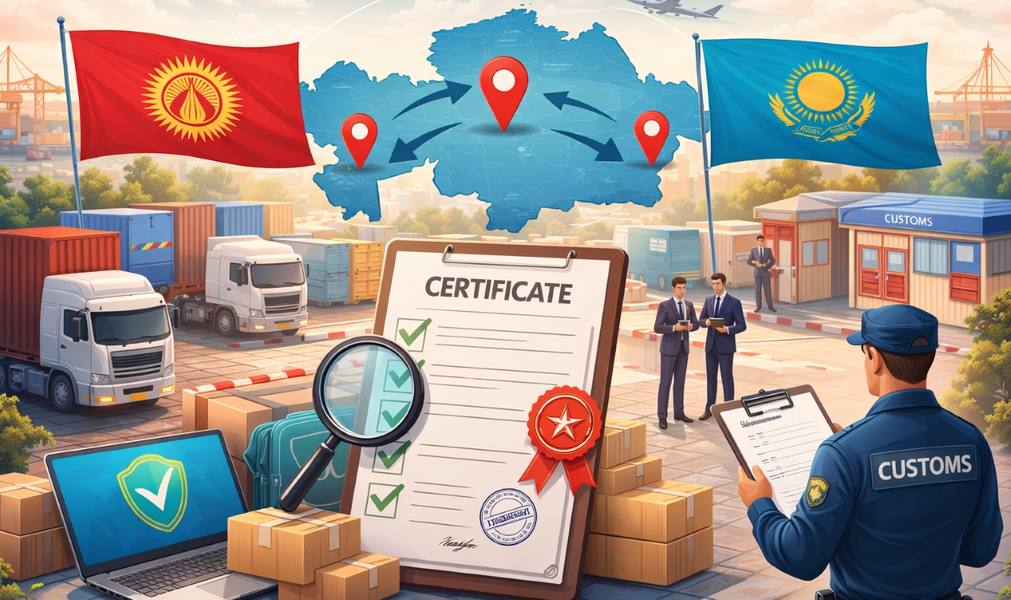
Until recently, the issuance of certificates through Kazakhstan and Kyrgyzstan was perceived as a convenient and almost risk-free tool for optimizing imports from China. This was an established practice enjoyed by both large importers and small companies.
However, in 2024-2026, the situation has changed markedly. The scheme itself has not disappeared, but its status has transformed from a “working solution” to a tool that requires a much more careful approach and understanding of risks.
How the scheme works
The mechanics remain the same. The goods are manufactured in China, then a certificate of conformity is issued in one of the EAEU countries. - most often in Kazakhstan or Kyrgyzstan- After that, the products are imported into Russia with ready-made documents.
From a formal point of view, there is no violation: the common space of the EAEU implies mutual recognition of certificates. This is where the popularity of the scheme was built.
But in practice, the key is not only the availability of the document, but how it was obtained and how it meets real requirements.
Why the scheme became widespread
The increase in popularity was due to pragmatic reasons. Certification in Kazakhstan and Kyrgyzstan has long been faster and cheaper than in Russia. - softer.
For businesses, this meant an opportunity to accelerate the turnover of goods, reduce costs and simplify the launch of new positions. This was especially important in the face of rising imports from China and pressure on margins.
As a result, by 2023-2024, the scheme became the standard for a significant part of the market.
What has changed in 2024-2026
The turnaround occurred when the volume of such supplies became too large. Regulators began to see this practice not as a private tool, but as a systemic phenomenon affecting quality control and product safety.
First of all, the customs position has changed. If earlier the presence of a certificate in itself was considered a sufficient basis for the release of goods, now this is no longer enough. The document is perceived as a reason for verification, not as its result.
At the same time, control over certification bodies has been strengthened. Increasingly, it is checked whether actual tests have been carried out, whether samples of products exist, and whether the information claimed corresponds to the actual characteristics of the goods. If violations are detected, certificates may be suspended or cancelled.
Special attention is paid to transit schemes, when the goods are not actually associated with the country that issued the document, and are immediately sent to Russia. Such cases are now most often subject to additional checks.
How customs looks today
The approach to risk assessment has become much more comprehensive. Customs authorities analyze not only the certificate itself, but also the entire supply chain: from the origin of the goods to the logic of its movement.
Suspicion is caused by situations in which there is no economic connection between the country of certification and the product. Also, attention is drawn to cases when documents are executed too quickly or at a clearly low cost.
In fact, we are talking about the transition from formal control to substantive. Customs is trying to understand whether the document is a real procedure or just its imitation.
The main risks for business
The main problem is that the risks have become not only legal, but also operational. Even if a company does not violate the law directly, it may face delays, additional checks and the need to re-register documents.
In more complex scenarios, it is possible to suspend the certificate, which automatically blocks the sale of goods. This is especially critical for companies working with marketplaces or large networks, where document requirements are becoming stricter.
The financial implications can also be significant, from additional certification costs to fines and losses due to contract disruption.
Does the scheme work now?
The scheme has not disappeared and is still in use. However, its effectiveness depends on the quality of execution.
If certification is carried out with real trials, through accredited bodies and with transparent documentation, the risks remain manageable. In this case, we are talking about legal work within the EAEU.
If a simplified approach is used - without actual testing and with minimal product testing- The likelihood of problems increases dramatically. Such cases are now the object of close attention from the controlling authorities.
When is the best time to abandon this model?
The practice of recent years shows that for complex categories of goods and large deliveries, such a scheme is becoming less and less justified. The higher the volume and the stricter the product requirements, the greater the likelihood of additional inspections and associated costs.
This is especially true for electronics, children’s goods and products sold through large trading platforms. In these segments, the requirements for documents are actually approaching the maximum.
Where the market is moving
The overall vector of development is obvious: there is a gradual transition to a more transparent and controlled certification model. Russian authorities seek to strengthen their own role in this process and reduce dependence on external mechanisms within the EAEU.
For business, this means increasing costs and complexity of procedures, but at the same time - Increase predictability and reduce the risk of supply blocking.
Certification through Kazakhstan and Kyrgyzstan is no longer a universal solution. It remains a working tool, but requires a much more careful approach and understanding of context.
A major change in recent years is that formal compliance is no longer enough. The real content of the procedure and transparency of the entire supply chain become key.