China vs India: The New Industrial Race
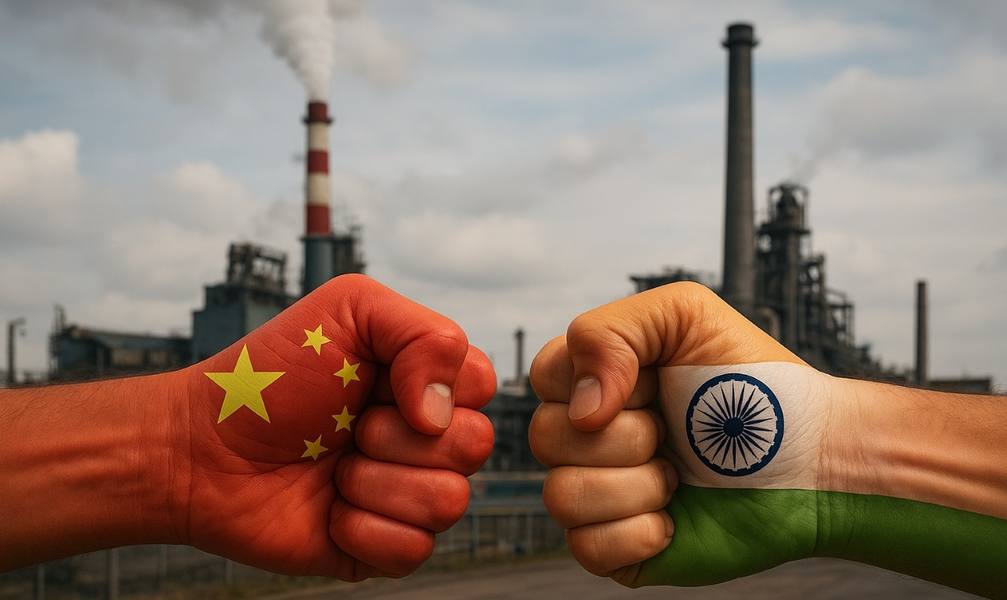
Two giants, one goal: the world factory.
China and India are Asia’s largest economies, competing for the same title: world manufacturing center of the XXI century.
Since 2022, India has been actively promoting Production strategy “Make in India”Offering investors cheap labor and tax incentives.
China, faced with rising costs and technological pressure from the West, is responding with a new wave. Industrial modernization and automation.
The year 2025 was the point when the competition between the two countries shifted from political slogans to real supply chains and the fight for customers in the global market.
From the World Factory to the Factory Network: The Context of 2025
Over the past 20 years, China has built a powerful industrial ecosystem. From chip manufacturing to finished carsGlobal brands are diversifying risk by opening factories in India, Vietnam and Indonesia.
In the 2010s, China controlled the 28% of global industry.
In 2025, its share decreased to 24%And India grew up with 2% to 5.5%.
This restructuring does not mean companies leaving China.
sooner, Transition from monoproduction to distributed supply chainsChina is becoming the center of technology and logistics, and India is the site for mass production.
Why India is Rising: The Three Whales of Industrial Rise
State program "Make in India 2.0"
India has launched the second phase of the program with a focus on 14 industries: electronics, automobiles, solar panels, pharmaceuticals and textiles.
Companies get:
- subsidies up to 6% of exports (Production Linked Incentive, PLI)
- tax holidays up to 10 years for new plants;
- simplified licensing regime for foreign investors.
Demographic advantage
The average age of the population in India 28 yearsagainst 39 years in China.
Every month the job market comes out. About a million young professionalsThey are willing to work for a third of the Chinese rate.
Western Demand for Diversification
Since the U.S.-China trade wars, Western corporations have sought to reduce their dependence on Chinese factories.
Apple, Samsung, Dell, Foxconn, Micron are already moving some of the build to India.
In 2025, Apple produces about 18% of all iPhones in India (versus 1% in 2020).
China’s response: Bet on technology and smart factories
Beijing realizes that “cheap labor” is no longer its advantage.
China's response: Transition from quantitative growth to qualitative.
“Made in China 2025” Program – Second Wave
By 2025, the program has moved into the second phase.
The main goal: automation and digitalization of production in 10 key industries:
- Robotics and Industrial IoT,
- semiconductors
- electric cars,
- biotechnology,
- new materials.
More than 70 percent of China’s large factories have already implemented smart manufacturing, such as sensors, autonomous logistics and AI monitoring.
Industrial clusters of the new generation
China is actively developing 5.0 industrial parks Integration of factories, logistics and R&D
- guangdong - Electronics, automotive industry;
- Jiangsu Robotics and chips;
- sichuan Batteries and energy-intensive production.
These clusters provide not only output, but also quick customization – something India has yet to achieve.
The Green Industry and ESG
China is investing in green factories, carbon monitoring and recycling.
More 60% of new businesses in 2025 In China, they are already using ESG standards.
This gives an advantage when dealing with Western brands that require green suppliers.
Logistics: Who has a stronger supply chain?
China: depth and infrastructure
- The 10 largest ports in the world are in China (Shanghai, Ningbo, Shenzhen).
- High-speed rail corridors connect ports with domestic factories.
- The FTZ (bond zones) system allows export and import processing in hours.
India: growth rate, but not stability
- The ports of Mumbai and Chennai are overloaded, the average container handling time is 3-4 days (in China, less than a day).
- Rail logistics is being modernized, but infrastructure within the country remains patchy.
- In 2025, India launched the "Dedicated Freight Corridors" (DFC) - freight routes to accelerate export flows.
Chinese logistics remains the benchmark for speed and transparency - 3rd in the world in the LPI (Logistics Performance Index), India - 38th.
The impact of the race on global supply chains
Diversification, not substitution
Global corporations are not leaving China. They're building double chains.:
- China - high-tech components and assembly of the premium segment
- India is a mass production and alternative market.
Growth of India’s domestic market
With a population of 1.43 billion, India is turning into a factory. consumptionThe one that consumes part of what is produced.
New logistics geography
The India-Middle East-Europe route is developing as an alternative to China’s Maritime Silk Road.
But China is actively strengthening land links through Kazakhstan, Russia and Central Asia.
The world ends up getting Two parallel logistics systems Chinese and Indian, which increasingly overlap, but do not replace each other.
What international companies choose
Manufacturing in China Production in India StrategyApplePremium Lines (Pro)Dual Supply ChainSamsungSmartphones and household appliances Balance of risksTeslaGigafactory Shanghai Talks about Gujarat plant DiversificationFoxconn27 factories in China4 complexes in India Expansion of capacityBYDChina, Thailand, Brazil Market Focus on Exports
In 2025, more 60% of Asia’s largest brands China +1 strategy – leaving China at the core, but adding one additional site (most often India).
Prospects: who will win the industrial race
China
- Better infrastructure
- Technology leadership
- Qualified personnel
- Cost growth
- Export restrictions pressure
India
- Demographic potential
- Low production costs
- Western support
- Weak infrastructure
- Problems with energy supply
Bureaucracy and regulatory risks
According to PwC forecast, by 2030 India will increase its share in the global industry to 8%.
China will retain about 22-23%It will become a leader in smart technologies, robotics and ESG manufacturing.
What it means for logistics and imports
- Suppliers will start divide up supply chainsSome of the components are from China and some are from India.
- The role grows regional hubs (Singapore, Thailand, UAE).
- Demand for multimodal transport Hybrid logistics schemes (sea + railway).
- Businesses will have to build. double-channelConsidering tariffs, certification and currency risks.
Not China or India, but China and India.
The race between the two giants is not a war for the factory title. redistribution.
China is becoming world-brainIndia is hers. muscle.
For business, this is not a threat, but an opportunity:
- diversifying risks,
- Optimize supply,
- Choose the best combination of price, technology and sustainability.
The world of the 2030s will not be monopoly. net-like China and India will remain at the center of this network.