Specific risks for certain categories of goods: where the business loses money
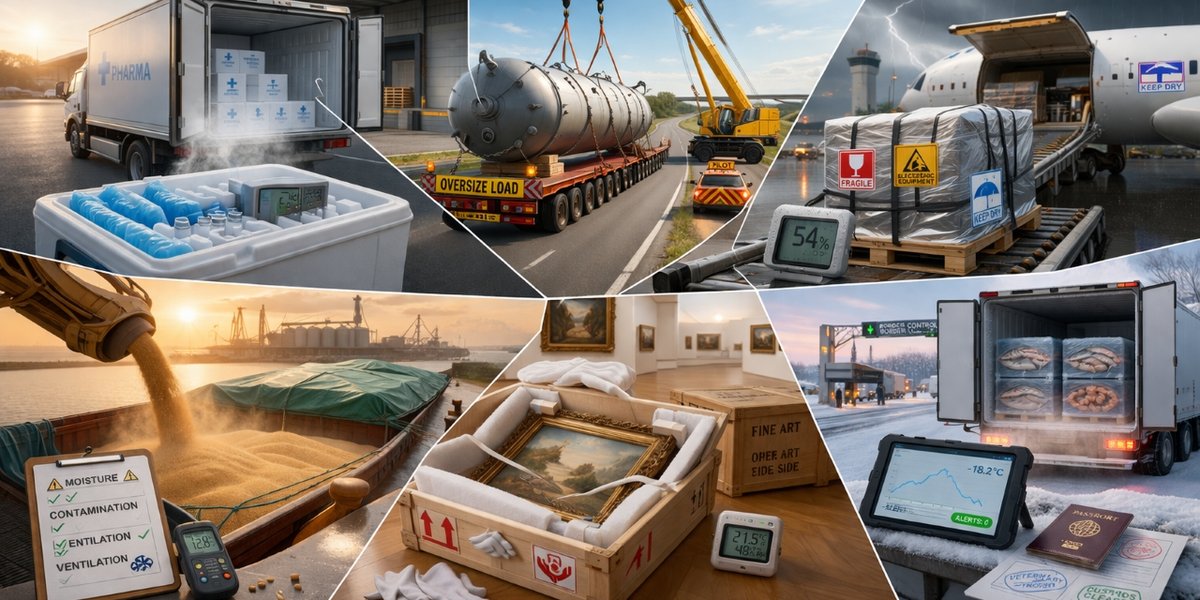
There are no universal risks in logistics. Each type of cargo forms its own set of problems that can arise at any stage. - from shipment to delivery to the final recipient.
The mistake of many companies is that they evaluate logistics “on average in the market”, not taking into account the specifics of the product. As a result, risks are underestimated and losses become systemic.
Understanding the characteristics of each category of goods - A key factor in business sustainability.
Why there is no universal approach
Logistics - It's not just moving from point A to point B. This is a complex system where:
- storage
- transportation requirements
- legal restrictions
- processing
The same route can be safe for industrial equipment and critical for food.
Food and agricultural products
This is one of the most sensitive categories.
The main risks are associated with a limited shelf life and strict requirements for transportation conditions. Even a slight temperature deviation or a delay at the border can lead to a complete loss of the lot.
Key issues:
- temperature disturbance
- Delays in monitoring
- Refusal to enter the market (especially when exporting)
- spoilage
Phytosanitary requirements and the need for strict documentary support create additional complexity.
Dangerous goods
Working with dangerous goods requires compliance with international standards and strict regulations.
Any mistake is here. - This is not only a financial loss, but also a risk to life and the environment.
Main risks:
- misclassification
- packing
- errors in documentation
- penalties
In addition, not all carriers are ready to work with such cargo, which limits the choice of logistics solutions.
Industrial equipment
At first glance, this is one of the “simple” categories. But in practice, this is where serious problems often arise.
The risks are related to:
- damage during loading and unloading
- fixation
- dimensionality
- technicality
In addition, oversized and heavy cargoes that require approvals and special routes complicate the process.
Container goods
Containerization has greatly simplified international logistics but has not eliminated risks.
Main problems:
- portage
- container shortage
- errors in documentation
- downtime
It is also important to consider the risks associated with cargo consolidation when goods from different shippers are in the same container.

Expensive and highly liquid goods
This category includes electronics, machinery, branded goods.
Primary risk - Theft.
Problems arise at different stages:
- storage
- transporting
- transfer
Further possible:
- substitution
- partial
- fraud
Packages
Collective transportation reduces the cost of logistics, but increases the number of risks.
Key challenges:
- loading
- Damage due to neighbourhood of goods
- extension
- control
The more participants in the chain, the higher the probability of error.
International transport
When going outside of one country, the number of risks increases multiplely.
Main factors:
- customs
- differences in legislation
- currency
- restriction
This is especially true when dealing with new markets where there is no experience.
Hidden risks that are often ignored
In addition to the obvious problems, there are less noticeable, but no less dangerous factors.
Among them:
- marking errors
- misspelling
- false information from the sender
- lack of insurance
These factors often cause serious losses, although they could have been prevented during the preparation phase.
How to build protection
Effective risk management is impossible without a systematic approach.
Basic principles:
- segmentation of goods by risk level
- selection of specialized carriers
- Enhanced monitoring at key stages
- insurance
- scrutinize
It is important not just to respond to problems, but to lay down mechanisms to prevent them in advance.
Balance between cost and security
One of the key dilemmas - The choice between cheapness and reliability.
Lower logistics costs often lead to higher risks. In the short term, this can be imperceptible, but in the long run it leads to losses.
Companies that understand this, build logistics not on the principle of “cheaper”, but on the principle of “controlled”.
Specificity of cargo - This is not a secondary factor, but the basis of the entire logistics strategy.
Ignoring the characteristics of the product leads to systemic errors, losses and instability of the business.
Companies that take these risks into account and build processes for specific categories of cargo gain a competitive advantage and stability in a constantly changing market.