ASEAN-China Economic Partnership

The economic partnership between ASEAN and China has long gone beyond conventional trade. Today, it is one of the key axes of international economic integration in the Asia-Pacific region, affecting not only the regional but also the global economy. Over the past three decades, dialogue partnerships have evolved into a complex system of interdependencies, with benefits increasingly accompanied by asymmetries of interests.
From dialogue to strategic engagement: how it all started
China became an ASEAN Dialogue Partner in 1991. This step was the starting point for building institutional dialogue and gradually deepening economic ties. In 2003, the cooperation was formalized as a strategic partnership, and in 2010 the China-ASEAN Free Trade Area (CAFTA) was launched.
At the same time, the ASEAN Economic Community was formed within the association itself, officially launched in 2015. His goal. - internal economic integration, free movement of goods, services and investments. China has become not just an external partner, but an active participant in this transformation.
For comparison, the Russia-ASEAN dialogue partnership, which began in 1996, has developed much more restrainedly and focused mainly on energy, security and selected infrastructure projects.
ASEAN-China Economic Cooperation
Trade and supply chains
Today, China - ASEAN’s largest trading partner. Its share in the total trade turnover of the Association countries steadily fluctuates in the range of 20-25%. ASEAN economic cooperation is increasingly woven into China’s production and logistics chains- from electronics and engineering to agriculture.
ASEAN, in turn, has the role of:
- production base,
- transit hub,
- a rapidly growing market.
Economic integration and asymmetry
ASEAN’s economic integration with China is progressing faster than the internal integration of ASEAN countries. This creates an imbalance: the ASEAN economic community is increasingly forced to adapt to Chinese standards. - From digital platforms to green technologies and infrastructure regulations.
In contrast, the Russia-ASEAN partnership does not form such a dependence: Russia remains an important, but niche partner, without systemic influence on the internal rules of the association.
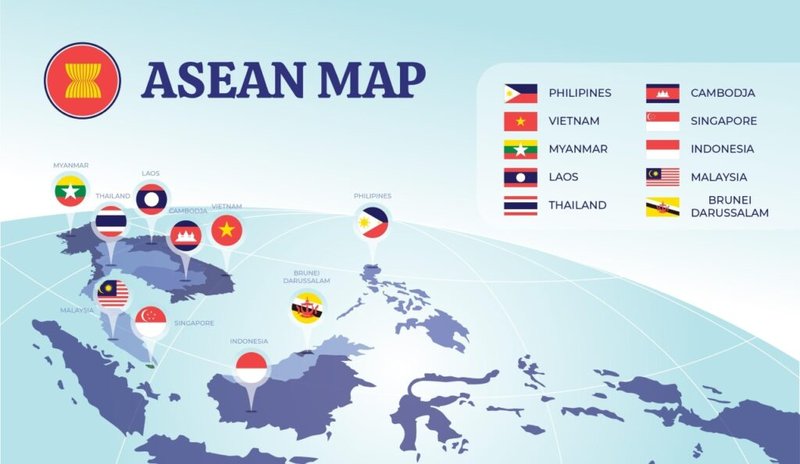
China and ASEAN: Problems of Interstate Dialogue
Despite the high level of economic cooperation, the problems of interstate dialogue remain significant.
Political and territorial contradictions
China and ASEAN face protracted disputes in the South China Sea. These differences undermine the unity of the association and expose the differences of interests among the countries of the region. Vietnam and the Philippines take a tougher stance, while Cambodia and Laos tend to back Beijing.
This is a major challenge for ASEAN’s dialogue partnerships, with economic cooperation increasingly intersecting with security and sovereignty issues.
Economic risks
Key risks include:
- Increased debt burden on infrastructure projects;
- ASEAN’s trade deficit with China;
- Chinese import pressure on local producers.
This is different from Russia-ASEAN cooperation, where economic cooperation is not accompanied by large-scale debt dependence and does not affect the internal political balances of the participating countries.
International Economic Integration and the Role of RCEP
The signing of the RCEP agreement in 2020 was an important stage of international economic integration in the region. It has united China, ASEAN and several other countries into the world’s largest free trade area.
For China, it is a tool for consolidating leadership. For ASEAN - Possibility to maintain multi-vector, but also the risk of strengthening the dominance of one center of power.
Future trends: where the balance is headed
What awaits the partnership next
In the medium term, the ASEAN-China economic partnership will follow a hybrid scenario:
- China will continue to increase its influence through investment and technology.
- ASEAN will seek balance by diversifying its partnerships with the EU, India and Russia.
- Strategic cooperation will increasingly be complemented by elements of competition.
Opportunities and recommendations
A key challenge for ASEAN - Strengthen internal unity and reduce asymmetry.
For China. - Maintaining trust through a more balanced dialogue.
For Russia, the dialogue partnership with ASEAN remains an opportunity to occupy a niche in energy, logistics and Eurasian projects without direct confrontation with Beijing.
ASEAN-China Economic Partnership - It is no longer just cooperation, but a complex system of mutual expectations, benefits and constraints. The balance is gradually shifting towards China, but ASEAN retains room for maneuver due to its institutional flexibility and diversity of dialogue partnerships.
Understanding these processes is important not only for policymakers, but also for businesses: this is where the architecture of Asia’s future economy is shaping.