Agricultural Quotas: The Hidden Mechanism of Global Trade
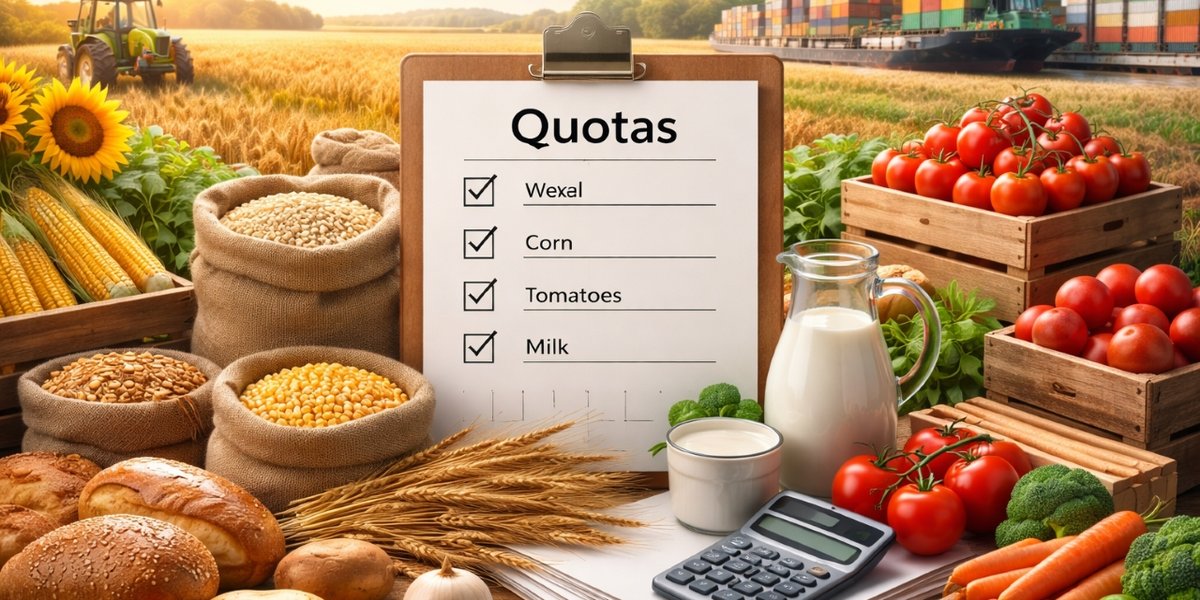
Agricultural quotas - One of the most underappreciated instruments of trade regulation. They are rarely spoken about outside a narrow circle of specialists, but it is quotas that largely determine the number of people. What, to what extent and under what conditions can be sold between countries. Their influence is especially noticeable in agricultural trade, where the economy, food security and geopolitics are intertwined.
We will understand what agricultural quotas are, what they are, what products are covered and why neither exports nor bank settlements are possible today without them.
What are agricultural quotas?
Agricultural quota - it State or interstate agreement limit on the volume of import or export of certain agricultural products for a specific period of time.
Simply put, the quota answers the question:
How much of this product can be sold or bought abroad on preferential or generally acceptable terms.
Quotas apply not to companies as a whole, but to specific commodity items - Grain, sugar, butter, meat, sunflower and so on.
Why countries need agricultural quotas
Agriculture - strategic industry. The state cannot rely only on the market. Quotas perform several tasks at once:
- protect the domestic market from deficits;
- stabilize prices within the country;
- support national producers;
- manage export flows;
- It is an instrument of negotiation with other countries.
Quotas are used especially actively during periods of crises, droughts, rising world prices and sanctions pressure.
What agricultural quotas are there?
In the direction of movement of goods
In practice, two types of quotas are most common:
- export limit the export of products from the country;
- imported Restrict the import of products into the country.
Export quotas are specific to countries - large producers of grain, sugar, oils. Imported - Countries that protect their agricultural sector.
Economic mechanism
Agricultural quotas may be:
- absolute a fixed limit in tons or units;
- tariff-- within the quota there is a preferential duty, and beyond it - elevated
- temporary This is for a season or a certain period.
In practice, the tariff model is most often used, as it gives more flexibility to the market.
Which products are most often given quotas
Farming almost always touches basic food products. This is not an accident – they are critical for food security.
The most common commodity groups
| Product category | Examples |
| Grain crops | wheat, corn, barley, peas, soybeans |
| Oilseed | flax, sunflower, rapeseed |
| Processing products | flour, vegetable oils, starch |
| Sugar and raw materials | raw sugar, beets |
| Animal husbandry | meat, dairy products |
The higher the social significance of the product, the higher the probability of quotas.
The working principle of the agricultural quota
The mechanism of quotas is simple, but in practice it involves several levels of control.
- The state sets the total quota.
- Determine the period of action (month, quarter, year).
- The quota is distributed among market participants.
- Exports or imports are carried out strictly within the allocated volume.
If the company exceeds the quota, apply or barrageOr a complete ban on surgery.
Who issues quotas and distributes volumes
In Russia, the following play a key role:
- Government of the Russian Federation;
- profile ministries (Ministry of Agriculture, Ministry of Economic Development);
- customs authorities.
Allocation of quotas may take place:
- on a historical basis (how much has been exported before);
- through applications;
- through licensing;
- less - through auctions.
For business, this means a necessity. Continuous interaction with the regulator.
How quotas affect banking transactions
This is one of the most sensitive and underrated aspects.
Banks when working with agricultural products look not only at the contract, but also at righteousness. If the goods fall under the quota, the bank checks:
- availability of a quota or license;
- compliance of the contract volume with the allocated quota;
- duration of permits;
- country of destination or origin.
What happens without a quota?
- payments hang;
- banks request additional documents;
- Increases the risk of blocking the transaction;
- It is possible to refuse the operation.
In fact, Quotas become an element of complianceNot just trade regulations.
Agriculture and geopolitics
Quotas - This is not just an economic tool, but a part of foreign policy.
Through state quotas:
- regulate supply to “friendly” markets;
- Restrict exports in times of tension;
- use food as part of negotiations;
- They protect internal stability.
This is particularly evident in the grain and vegetable oil market, where a single regulatory move could affect global prices.
What do business quotas do in practice?
With competent work, quotas can be not a limitation, but an advantage:
- predictability of supply;
- protection against sudden market fluctuations;
- reducing competition within the quota;
- More sustainable bank settlements.
But for this, quotas must be built into strategyIt is not a temporary formality.
Agricultural quotas - It is a complex but logical tool for regulating agricultural trade. They protect the market, influence prices, determine export routes and even directly affect banking transactions.
For business quotas- This is not only a limitation, but also gameplayKnowledge of which gives a competitive advantage. In the context of global instability, it is the ability to work with quotas that increasingly determines who can trade and who can trade. - Nope.