Instructions for suppliers of goods to Russia: what data are needed to accurately calculate delivery and pass customs clearance

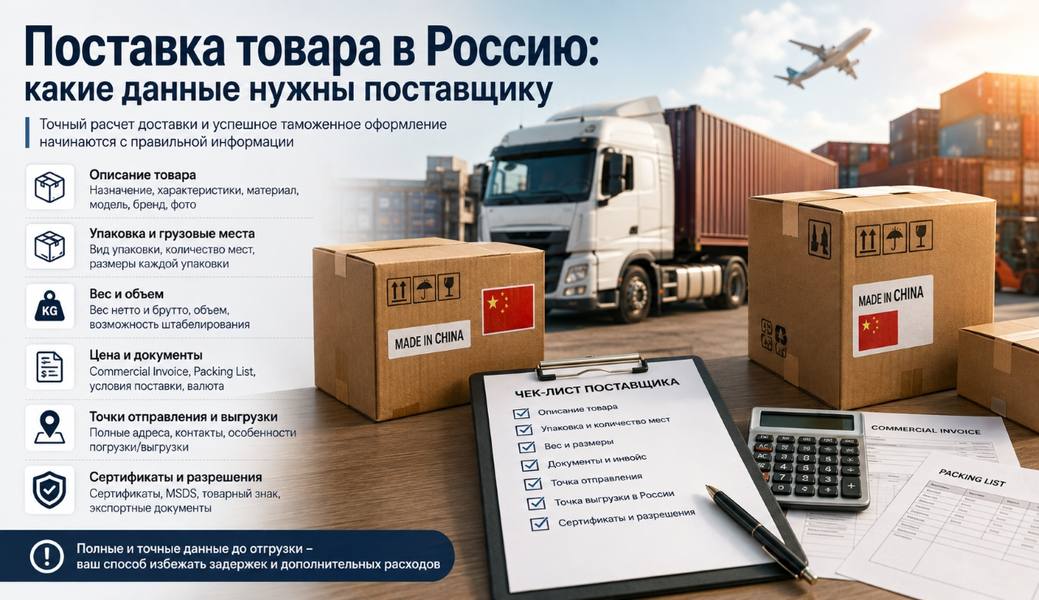
Professional delivery training begins not from the call of the car or from the payment of goods
The delivery of goods from China or another country to Russia is rarely disrupted by one big mistake. More often the problem arises because of Incomplete or inaccurate information at the start.
The supplier wrote the generic name of the product instead of the technical description. Indicated an approximate weight. The actual size of the package was not reported. In an invoice one price, in a commercial document another. Notified of battery, chemical composition or registered trademark.
As a result, after the start of transportation, it is found that:
- HS code requires clarification;
- Additional permits are needed;
- changing the cost of transportation;
- cargo takes up more seats than stated;
- There are questions about the customs value;
- the goods cannot be accepted in a particular warehouse;
- a special delivery scheme is required;
- The carrier refuses to perform the operation in the stated format.
Therefore, the professional preparation of the delivery begins not from the call of the car or from the payment of goods.
It starts with the right data package.
It allows you to assess logistics in advance, check the features of the goods, prepare documents and reduce the risk of delays at the border and during customs clearance.
Commercial, transport and permitting documents as a whole form the basis of the information chain of foreign economic activity: in the official materials of the EEC, the contract, commercial invoice, packing list, specification, transport and permits directly appear among the standard documents.
Below is a detailed guide that can be used as Single checklist for the supplier before shipment of goods to Russia.
Why you can not expect delivery of one photo of the product
The same product visually can look almost the same, but relate to completely different product categories.
For example, “electric lamp”, “lighting equipment”, “light fixture”, “light fixture part” or “lighting system component” are not just different formulations.
For logistics and customs clearance can be important:
- destination of the goods;
- material of manufacture;
- principle of operation;
- technical specifications;
- composition;
- configuration;
- producer;
- brand;
- country of origin;
- packaging;
- cost;
- mode of delivery.
That is why professional calculation is not based on the principle:
“We have 10 boxes of equipment, how much will the delivery be?”
And on the principle:
What exactly is in each box, how the product is used, what it consists of, how much it costs and under what conditions it is supplied?
The more accurate the source data, the more accurately it is possible to define the logistic scheme and see the potential limitations in advance.
Customs authorities, in particular, pay attention to the sufficiency and reliability of documents and information that confirm the declared characteristics of the goods, its cost and classification. In case of insufficient documentary evidence, additional checks and inquiries are possible.
Block 1. Product description: where does the calculation start?
1. What kind of product?
The first thing that needs to be done is normal, clear description of the goods.
Nah:
Equipment
Parts
Goods.
Clothes
Chemicals
Specific description:
LED industrial lamp for lighting warehouses.
Or:
Women's polyester jacket with insulation, for everyday use.
Or:
Metal pump for pumping technical water, electric.
A good description should answer the main question: What is it and how is it used?
For professional evaluation, it is desirable to indicate:
- name of the goods;
- appointment;
- scope of application;
- the main technical characteristics;
- material;
- model;
- article;
- producer;
- brand.
The more complex the product, the more important the technical documentation.
For equipment, it is desirable to immediately provide:
- technical passport;
- specification;
- catalogue;
- datasheet;
- instruction;
- photographs;
- link to the manufacturer's website.
General formulations may not be sufficient for accurate classification. Official explanations from customs authorities also emphasize the importance of detailing the characteristics of the goods rather than using generic names.
2. Scope of the goods
Sometimes similar products can be used in completely different ways.
Therefore, it is important for the supplier to explain:
- where the goods are used;
- for whom it is intended;
- whether it is consumer;
- industrial;
- professional;
- medical;
- construction;
- automobile;
- agricultural.
For example:
Knife - too general a description.
We need to understand:
- kitchen;
- industrial;
- folding
- instrumental;
- part of the equipment.
Plastic container - too wide.
It's important to know:
- for food products;
- for chemicals;
- for domestic use;
- for industrial equipment.
The purpose of the goods affects not only the description in the documents. It can be significant for classification, assessment of the need for permits and determining the specifics of delivery.
3. fabrication
The material should be indicated as accurately as possible.
Especially when it comes to:
- textiles;
- clothing;
- furniture;
- shoes;
- construction materials;
- articles of metal;
- plasticity;
- combined goods.
For example, instead of:
Textile bag
better:
Polyester bag, outer layer - 100% polyester, lining - polyester, fittings - metal.
For complex products, it is important to understand:
What is the product made of?
And what material performs the main function.
This is especially important for combined products where:
- metal;
- plastics;
- glass;
- textiles;
- tree
- electronic components.
4. Photos and product references
Photographs are not a formality.
They allow you to see:
- construction;
- method of use;
- material;
- completeness;
- marking;
- packaging;
- brand;
- model.
Ideal to provide:
- general type of goods;
- view from different sides;
- packaging;
- label;
- nameplate;
- manufacturer's marking.
If the product has a manufacturer’s page, attach a link.
But it's important to remember: The reference does not replace the technical description.
The site can have several versions of one model, and the batch supplied may differ in characteristics.
Therefore, it is better to use the rule:
Link + photos + specification + exact description of the batch.
Block 2. Packaging: This is where shipping costs often change
One of the most common mistakes is to assume that there are enough boxes to calculate.
In fact, more accurate data is needed for logistics.
1. Type of package
Specify:
- cardboard box;
- wooden box;
- pallet;
- plywood box;
- sack
- plastic container;
- metal packagings;
- non-standard packaging.
This is important to understand:
- the possibility of stacking;
- overload requirements;
- risk of damage;
- the need for additional packaging;
- Features of accommodation in a container or car.
2. Number of cargo packages
It should be specified:
Not the number of items, but the number of loads.
For example:
- 1,200 units of goods;
- 48 boxes;
- 4 pallets.
These are three completely different indicators.
For the calculation of transportation, cargo spaces are usually the basic unit of logistic information.
3. Size of each cargo space
It is necessary to provide: Length × width × height.
For example: 120 × 80 × 150 cm – 6 pallets.
If the size of the boxes varies, the data for each group must be indicated.
Bad: 30 boxes, roughly the same.
Right:
Number of
20 boxes
10 boxes
Size
60 x 40 x 40 cm
80 x 60 x 50 cm
So you can calculate in advance:
- volume;
- accommodation;
- the need for a container;
- Possibility of consolidation;
- features of overload.
4. Gross and net weight
The supplier must provide both values.
Weight net.
That's the weight of the product itself.
Gross weight.
This is the weight of the product along with the packaging.
For logistics, it is especially important that the data factual, not approximate.
Phrase: About 500 kg
It is not enough for professional calculation.
Better:
Gross weight: 527.4 kg
Net weight: 481.6 kg
Even a small difference between the declared and actual characteristics can create additional questions during the acceptance and clearance stages.
5. Container and method of loading
If shipping is intended, it is important to understand in advance:
- which container is suitable;
- Is it possible to download at 20′ or 40′?
- Do you need a High Cube?
- Can the cargo be stacked?
- Are there any height restrictions?
- whether attachment is required;
- Are there fragile elements?
- Whether joint transportation with other goods is allowed.
Sometimes the supplier offers the container on its own, but this solution is not always optimal for the entire logistics chain.
Therefore, packing parameters are better transmitted before booking and loading.
6. Packing List - secondary
The packaging sheet should reflect the real structure of the cargo.
It is desirable that it be clear from it:
- What is in each package;
- number of units;
- weight
- dimensions;
- box numbers;
- pallet numbers;
- marking.
Professional Packing List allows you to quickly match documents with the actual cargo.
Packaging list is one of the basic commercial documents used at various stages of foreign trade and customs clearance.

Block 3. Price and Invoice: Why “Example Value” Is Not Enough
For the calculation of delivery and customs clearance is necessary cost of a particular batch supplied.
Not a catalog price.
Not the cost of a similar product.
Not the price of the last order.
The cost of the goods that are actually shipped.
What needs to be provided
Commercial Invoice
The document should contain agreed information:
- seller
- buyer;
- number and date of invoice;
- name of the goods;
- quantity;
- price per unit;
- total cost;
- currency;
- terms of delivery.
For complex deliveries, it is desirable that the description of the goods in the invoice does not contradict:
- contract;
- specifications;
- Packing List;
- transport documents;
- actual goods.
Customs value should be documented, and in the absence of sufficient evidence, additional issues and control procedures are possible.
Important Principle: Documents must refer to the same product
For example:
Invoice: Industrial Pump Model X200
Packing List: Water Pump
Website: High Pressure Chemical Pump
On the product itself: X200-C
Each of these differences may require further clarification.
Therefore, before shipment, it is necessary to conduct a simple but important check: Do the data match in all the documents?
Block 4. Point of departure: it is not just the name of the city
To build a route, it is necessary to specify:
- the full address of the warehouse or factory;
- city;
- province;
- contact person;
- warehouse hours;
- Features of loading.
It is also important to inform in advance:
- the goods are ready or are still being made;
- whether partial shipment is possible;
- Is there a time limit for loading?
- whether there are loading equipment;
- Pre-registration of the vehicle is required;
- It is possible to pick up cargo from several addresses.
The terms of delivery also matter.
It is necessary to understand the conditions under which the goods are transferred to the carrier.
For example:
- EXW;
- FOB;
- FCA;
- CIF;
- other agreed terms.
The distribution of responsibilities between the parties depends on this.
Therefore, the logistics company needs to transfer not onlyThe terms of delivery agreed between the seller and the buyer.
Block 5. Point of unloading in Russia
The mistake many senders make is to assume that the final city automatically means a clear delivery scheme.
For example: Moscow.
But Moscow is not an unloading address.
To organize delivery, you need:
- city;
- exact address;
- type of warehouse;
- contact of the recipient;
- working hours;
- requirements for the vehicle;
- possibility of arrival of large-sized transport;
- presence of a ramp;
- availability of a forklift;
- The need for a prior pass.
Sometimes it is the final point that determines which transport to use.
Block 6. Certificates and permits
Before sending, it is necessary to check whether documents confirming compliance with mandatory requirements are required for the goods.
Depending on the goods, these can be various permits provided for by technical regulation and other requirements.
Therefore, at the start it is important to provide:
- precise description;
- composition;
- technical specifications;
- model;
- appointment;
- photographs;
- Manufacturer's documents.
It is on the basis of complete information that it is possible to correctly determine what documents may be required for a particular product.
Security Certificate and MSDS
If the goods belong to chemical products or contain substances that may be of importance for transportation and storage, please inform in advance.
A safety passport or other document with information about the composition and properties of products may be required.
It is especially important not to hide the presence of:
- batteries;
- batteries;
- liquids;
- chemical components;
- aerosol;
- flammable substances.
This information affects not only the design, but also the possibility of transportation by a specific mode of transport.
Trademark and international registration
If a well-known brand or registered trademark is present on the product, it is necessary to inform about it in advance.
It is important to provide:
- brand name;
- photographs of markings;
- producer;
- documents confirming the origin and legality of the delivery, if any.
Intellectual property verification is a separate important block of delivery preparation.
Export documents and value of goods
If the goods are shipped from China, it is necessary to determine in advance which documents accompany the specific export operation.
The following should also be agreed:
- export documents;
- data on the sender;
- product data;
- cost;
- quantity;
- description.
The key principle remains unchanged:
The documents must reflect the actual transaction and the actual goods.

The most important part of the instructions: all data must be provided before shipment
In practice, most difficulties can be identified in advance.
If it is known before dispatch:
- exact goods;
- technical description;
- photographs;
- composition;
- quantity;
- packaging;
- dimensions;
- weight
- cost;
- terms of delivery;
- address of departure;
- discharge address;
- necessary documents,
It is possible to build a supply as a managed process.
The main conclusion: the supplier is not only responsible for the production of goods
In modern international supply, the manufacturer or supplier is part of a single logistics chain.
The quality of information on the supplier side depends on:
- accuracy of calculation;
- the ability to choose the right route;
- correctness of classification of goods;
- preparation of necessary documents;
- speed of acceptance;
- the possibility of additional requests;
- compliance with delivery schedule.
Professional delivery begins with a simple rule:
Do not send cargo until everyone in the chain understands what is being shipped, how much it is being shipped, how it is packaged, how much it costs and under what conditions it should be delivered.
The earlier discrepancies are identified, the cheaper it is to correct them.
Correct product description before shipment - Just.
Correct the packing sheet loading - relatively easy.
Detecting a problem when the cargo is already in transit or has arrived for clearance is already a matter of time, additional costs and restructuring the entire logistics chain.
This is a good guide for the supplier. - It's not bureaucracy. It's a risk management tool.
And the more accurately the supplier works with data, documents and packaging, the more predictable the delivery to Russia becomes.