Import of goods from China: 10 stages from finding a supplier to receiving goods

Successful delivery begins before negotiations with the factory
Buying goods in China can look like a simple scheme: find a supplier, negotiate a price, pay the order and wait for delivery. In practice, there is a whole chain of stages between the first contact with the factory and the receipt of goods in Russia.
You need to check the manufacturer, agree on the terms of the transaction, choose the method of delivery, prepare documents, deal with certification, pass customs clearance and only then accept the goods.
If you skip one of the stages or perform it formally, the final cost of delivery may be higher than planned, and the transaction itself may face delays or additional costs.
We will analyze the whole process by steps - from finding a Chinese supplier to analyzing the results of the transaction.
Stage 1. Finding a supplier in China
The first task is to find a company that is really able to deliver the necessary goods in the right quantity and with the right characteristics.
You can find suppliers through different channels:
- profile exhibitions;
- business contacts;
- search engines;
- specialized trading platforms;
- recommendations of partners;
- professional intermediaries.
The supplier is not necessarily a suitable supplier.
Before negotiations, it is necessary to collect basic information about the company:
- What does the manufacturer do?
- What products does it produce?
- where the production is located;
- How many years of work?
- what volumes can be produced;
- Does it work with exports?
- which markets are already serving;
- Is it possible to produce goods according to individual requirements?
Don’t start with the minimum price question.
One common mistake is to send multiple companies a single request with a single question: “How much does it cost?”
The prices received may not be comparable.
One supplier can offer goods with one configuration, the other with another. Somewhere the price will be indicated for a certain amount, and somewhere for a minimum lot.
Therefore, it is better to form the request as specific as possible: specify the characteristics, quantity, packaging, quality requirements and expected delivery conditions.
So the comparison of sentences becomes much more accurate.
Stage 2. Negotiation and harmonization of modalities
After choosing a potential supplier, negotiations begin.
At this stage, it is necessary to agree not only on the price, but also on the main terms of the future transaction.
Discussed:
- price;
- quantity of goods;
- quality;
- Product characteristics;
- timing of production;
- delivery time;
- packaging;
- configuration;
- terms of payment;
- terms of delivery.
If the goods are manufactured specifically for the customer, it is important to agree in advance all technical parameters.
To do this, it is useful to use the specification, which fixes the characteristics of a particular product.
For example:
Parameter | What to fix |
Model | Exact marking |
Number of | Volume of party |
Materials | Composition and characteristics |
Colour | Code or agreed sample |
Size | Exact parameters |
Packaging | Type and quantity in the box |
Marking | Application requirements |
Completement | All elements of delivery |
The more detailed the conditions are, the less space there is for discrepancies after production.
Price is not the only subject of negotiation
Sometimes the supplier is ready to reduce the price, but at the same time change the packaging, package or production time.
Therefore, it is better to discuss the overall economics of the transaction, not just the value of a unit of goods.
For example, a more expensive supplier may offer:
- better packaging;
- a lower percentage of marriage;
- Shorter deadlines;
- convenient equipment;
- More suitable payment terms.
As a result, his offer may be more profitable.
Stage 3. Conclusion of a contract
After agreeing on the terms, the parties proceed to the conclusion of the contract.
It should consolidate the agreements reached during the negotiations.
Particular attention should be paid to:
- the subject of the contract;
- quantity of goods;
- characteristics;
- cost;
- timing of production;
- delivery time;
- terms of payment;
- packaging;
- liability of the parties;
- the procedure for working with marriage;
- Document requirements.
If the goods are manufactured according to the model, technical specification or individual specification, these materials should be made part of the contract documents.
A useful technique - fix the standard of goods
If color, appearance, material or other parameters are important, it is desirable to agree on a specific sample.
Then, when accepting, you can compare the received products not with a photo in correspondence, but with a pre-approved standard.
This is especially important for repeat orders.
Stage 4. Logistics
After the conclusion of the contract, it is necessary to determine how the goods will be delivered from China.
The task of logistics is to choose the optimal route, taking into account the cost, timing and characteristics of the cargo.
When choosing a delivery method, take into account:
- volume of cargo;
- weight
- the nature of the goods;
- deadlines;
- place of departure;
- destination;
- transportation requirements;
- budget.
Also predetermined:
- delivery time;
- packaging requirements;
- mode of transport;
- route.
Cheaper doesn’t always mean more profitable.
The cheapest delivery option may be inconvenient for a particular shipment.
For example, if the goods are needed by a certain date, saving on transportation becomes meaningless if delivery is delayed due to a longer route.
Therefore, it is better to consider logistics together with the entire transaction, rather than choosing separately from the purchase.
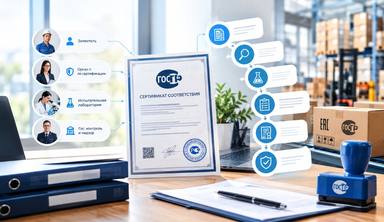
Stage 5. Certification
Before sending the goods, it is important to determine what requirements are imposed on the products when imported into Russia.
For different products, the requirements are different.
It may be necessary to:
- determine the need for confirmation of conformity;
- Select the appropriate form of the document;
- to check the characteristics;
- prepare the necessary information;
- Make sure that the documents relate to the imported products.
It is important not to postpone the issue at the time of arrival of the cargo.
Why Certification Is Better to Check Before Ordering
Imagine the situation: the goods have already been produced, paid for and is on the way to Russia, and then it turns out that a certain document is required for its import.
This can lead to additional costs and delay in registration.
Therefore, it is desirable to determine the requirements for products at the planning stage of the transaction.
Stage 6. Preparation of supporting documents
In parallel with logistics and certification, a set of documents is formed that will be needed for transportation, customs clearance and further use of goods.
Depending on the specific transaction can be used:
- invoice;
- packing sheet;
- certificate of conformity or other supporting document;
- declaration;
- technical documentation;
- instruction;
- other documents for the goods.
It is very important that the information in the documents coincide.
There should not be a situation where one quantity of goods is indicated in the invoice, another in the packaging sheet, and a third name appears in the documents for the products.
Check documents before sending
This is one of the easiest ways to avoid problems.
Before shipping, it is useful to check:
product name → quantity → cost → weight → number of seats → characteristics → supplier data → buyer data
If the error is detected before sending, it is usually easier to fix it.
Stage 7. Customs clearance
After the arrival of the goods, the customs clearance stage begins.
Here it is necessary to correctly determine the parameters of the cargo and calculate the corresponding payments.
The process may take into account:
- classification of goods;
- customs value;
- customs payments;
- taxes;
- accompanying documents;
- Requirements for a specific type of product.
Why Customs Expenses Should Not Be Considered “Roughly”
An error in the preliminary cost calculation can significantly affect the economy of the entire purchase.
Therefore, even before placing an order, it is desirable to calculate not only the cost of the goods from the manufacturer, but also the future costs of its import.
Conditionally cost can be considered as follows:
goods + packaging + delivery in China + international transportation + insurance + customs payments and taxes + certification + delivery in Russia.
Only this amount allows you to understand the real cost of delivery.
Stage 8. Delivery and reception
After passing the necessary procedures, the goods are delivered to the recipient.
But acceptance is not just about getting boxes in stock.
It is necessary to check whether the goods correspond to what was ordered.
It is advisable to check:
- number of seats;
- integrity of packaging;
- quantity of goods;
- models;
- completeness;
- appearance;
- characteristics;
- the presence of damage;
- Compliance with accompanying documents.
If the goods are purchased in a large batch, it is better to carry out the acceptance system.
You can use a pre-prepared checklist and record detected deviations.
What to do when detecting problems
If the acceptance found insufficient goods, damage or non-conformity to the characteristics, the problem must be documented.
Good to have:
- photographs;
- video unpacking;
- acceptance act;
- packing data;
- information on quantity;
- Correspondence with the supplier.
The better the problem is fixed, the easier it is to discuss it with the supplier and carrier.
Stage 9. Payment
Payment is not only a financial stage, but also a part of risk management.
The terms of payment must be agreed at the negotiating stage.
It's important to understand:
- When an advance payment is made;
- which part is paid in advance;
- When the final calculation is made;
- what conditions are associated with production;
- What documents confirm the fulfillment of obligations.
For large orders, it is especially important to think about the financial scheme of the transaction in advance.
It is necessary to take into account not only the price of the goods, but also the entire amount of money that will be required before its actual sale.
Stage 10. Completion of the transaction and analysis of the result
Receiving the goods and the final settlement does not mean that the transaction is worth simply closing and forgetting.
After delivery, it is useful to do a little analysis.
Let's compare:
- planned cost and actual cost;
- the amount claimed and the actual amount;
- expected quality and result;
- planned and realistic deadlines;
- logistics costs;
- customs expenses;
- number of marriages;
- additional costs.
This gives a real picture of delivery efficiency.
Why Analyze the First Delivery
Let’s say the goods were of high quality, but the delivery took longer than planned.
Or the manufacturer's price was attractive, but packaging led to additional costs.
Or the supplier fulfilled the order well, but the next batch must be ordered earlier due to the long production.
All these findings will be useful in the next purchase.
How to Turn First Delivery into a Work System
After the transaction is completed, it is worth saving all information.
It is useful to create your own database:
- contact of the supplier;
- agreed prices;
- characteristics of the goods;
- photographs of samples;
- specifications;
- documents;
- timing of production;
- actual delivery time;
- acceptance results;
- identified problems;
- total cost.
When re-ordering such a database significantly reduces the preparation time.
In addition, it is possible to compare several suppliers not by impression of correspondence, but by the real results of previous transactions.
Checklist of import of goods from China
Before starting the delivery, it is convenient to go through a short list:
1. Supplier
Has the manufacturer been tested and confirmed?
2. Goods.
Are the characteristics, quantity and equipment fixed?
3. Price.
Is the final cost of the product and the conditions of its formation clear?
4. Treaty
Are the key terms of the transaction fixed?
5. Logistics
Is there a suitable route and transportation?
6. Certification
Are the requirements for a particular product checked?
7. Documents
Is there a complete set and do all the documents match?
8. Customs
Are customs duties and taxes calculated?
9. Admission
Is there a plan to inspect the goods after receipt?
10. Analysis
Are the results of the transaction recorded for the next order?
The main life hack: not to count the price of the goods, but the entire delivery
One of the most important ideas when working with Chinese suppliers is not to dwell on the price in the commercial offer.
If the factory offers goods for a conditional $ 10, this does not mean that $ 10 will make its cost for the business.
After adding logistics, packaging, customs duties, taxes, certification and other costs, the total amount may change.
Therefore, it is better to compare suppliers by the final cost of delivery, and not only by the price at the plant.
Outcomes
Import of goods from China is a sequence of related stages.
First, you need to find and check the supplier, then negotiate and fix the characteristics of the goods. After the conclusion of the contract, logistics are selected, certification requirements are checked and accompanying documents are prepared.
The next stage is customs clearance, after which the goods are delivered to the recipient and accepted.
To complete the transaction is not just payment, and the analysis of the result: how much the actual costs, timing and quality matched the original plan.
The main thing is not to consider the purchase as separate actions “buyed → sent → received”. Successful delivery begins before negotiations with the factory and ends only after the business understands its real cost and can use the experience gained for the next order.