Why Your Team Only Works 50% of Its Potential


Expert article from business mentor and neuro-coach Maria Kuznetsova.
In this article, Maria Kuznetsova, a business mentor and neuro-coach, will talk in the first person about what each leader really cares about: the effectiveness of the team. And at the end of the article, we will share Maria’s contacts so you can get advice and discuss how to unlock the potential of your team.
In my 22 years at large companies as a senior executive, including CFO, I’ve learned one important thing: how a team looks on the outside is often fundamentally different from what happens on the inside.
I worked in various fields - from construction to hotel business, from production to retail. I saw the same picture everywhere: teams are only using half of their real potential. And the most interesting thing is that neither the managers nor the employees themselves realize this.
Here are 5 hidden reasons why this happens and what to do about it.
1. Lack of true focus
You know the situation? The team seems to be actively working, everyone is busy, but the results are not impressive. When I was in leadership positions, I was constantly faced with this: people confuse activity with productivity.
Why is this happening? Because there is no clear understanding of the main goal. Everyone sees only his work, but does not understand how it affects the overall result. It's like sailing on a ship where everyone rows their way.
This is especially true in large corporations such as Tele2. I have often found that the process is for the sake of the process, not for the sake of the result. And no one is responsible. It's certainly sad. The result is large losses that become noticeable only after a long time, when it is no longer possible to eliminate them. Naturally, this negatively affects the financial performance of the company.
2. Complex path syndrome
I see this phenomenon very often. The team deliberately complicates simple tasks while ignoring obvious solutions. Why? This is often due to fear of responsibility and uncertainty. It is easier to create the appearance of difficult work than to take and do something simple but effective.
At one of the Hilton hotels, I was confronted with a situation where employees were convinced that they would not be able to receive a budget bonus. Although the decision lay on the surface: we revised the pricing and within a month brought the hotel out of the minus in the plus.
3. Roles vs Reality
Every team has formal and informal roles, and often they don’t match. Someone is listed as the head of the department, but in reality the team is led by a completely different person. Someone officially takes an ordinary position, but it is to him that everyone goes for advice.
A lack of understanding of real roles leads to people’s potential being misused. It’s like trying to hammer a nail with a screwdriver – it’s like a tool too, but not the right one.
4. Collective blocks
You know what's most interesting? Teams, like individuals, share limiting beliefs. “We can’t do it,” “Nobody does it,” “We tried it, it doesn’t work.” These attitudes are so deeply rooted that they become part of the corporate culture.
Imagine a new idea or opportunity comes along and the team automatically rejects it without even trying it. How many opportunities for growth are lost because of this?
5. Unrealized synergies
Often from managers you can hear: “Every employee is a professional, but together they somehow do not give the desired result.” It’s like an orchestra, where every musician plays his part masterfully, but instead of a symphony, you get a cacophony.
Why is that? Team synergy is not about the professionalism of individuals. It is about how they interact, understand each other, support and complement each other.
What do we do with all this?
Over the years of working with different teams, I’ve learned that seeing these hidden causes through routine surveillance or interviews is almost impossible. People show “right” behavior, say “right” things. Real patterns only appear in non-standard situations.
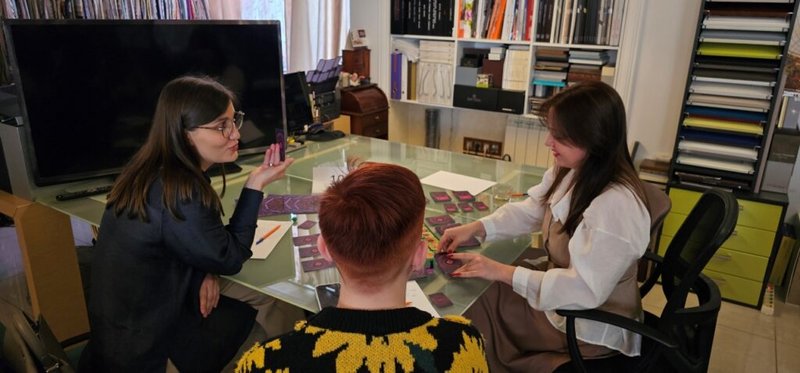
That is why I developed a special methodology in a game form for diagnosing commands. Through the game mechanics in 4 hours reveals what is usually hidden for months or even years:
- Who is the real leader and who is the leader?
- Where are the blocks and limitations of the team.
- What roles really suit who?
- How to increase interaction between employees.
Most importantly, people see their limitations and find ways to overcome them. It's not a situation where a consultant comes in and tells you what to do. This is the moment when the team finds its own path of development.
If you recognize your team in these descriptions, let’s talk.
I will help you see the real picture and find growth points. Trust my experience: every team is capable of much more than it seems at first glance.