Why it is important to measure cargo correctly before shipping: tips from logistics companies


The more accurate the initial data, the less likely additional costs are to arise.
Exact dimensions - This is not a formality, but a way to avoid unnecessary expenses.
Before shipping cargo, most transport companies ask the customer to provide its exact dimensions, weight and type of packaging. At first glance, this may seem a simple formality, but it is these data that determine the cost of transportation, the choice of transport, the safety of delivery and the timing of the order.
Measurement errors can lead to a change in the tariff after receiving the cargo, the need to replace transport or even to a delay in shipment. That is why professional carriers recommend first preparing the cargo, safely packing it and only then making final measurements.
Why do sizes matter?
The cost of transportation is calculated not only by the actual weight of the cargo. In many cases, the concept is used. volume-weight.
For example, a light but bulky cargo takes up as much space in the body of a car or container as a heavy one. Therefore, the carrier focuses not only on kilograms, but also on the volume that takes up the departure.
That is why the exact dimensions allow you to determine in advance:
- cost of transportation;
- the required type of transport;
- Possibility of consolidation with other goods;
- method of placement in the body or container;
- The need for additional packaging.
The more accurate the initial data, the less likely additional costs are to arise.
Why You Should Pack Your Cargo First
A common mistake is to measure the product before packaging.
After using boxes, protective corners, pallets, stretch films or tape windings, the dimensions can increase significantly.
It is important for the transport company. final dimensions of cargo ready for dispatch.
Therefore, the correct sequence looks like this:
- pack the products;
- securely fix the packaging;
- install the load on the pallet if necessary;
- perform the final measurements;
- report the data to the carrier.
This approach excludes the recalculation of the cost after receiving the goods.
What parameters should be measured
For registration of transportation usually requires several basic indicators.
Length maximum horizontal size.
Width The distance between the most distant side points.
Height. measured from the base to the highest point of the packaged cargo.
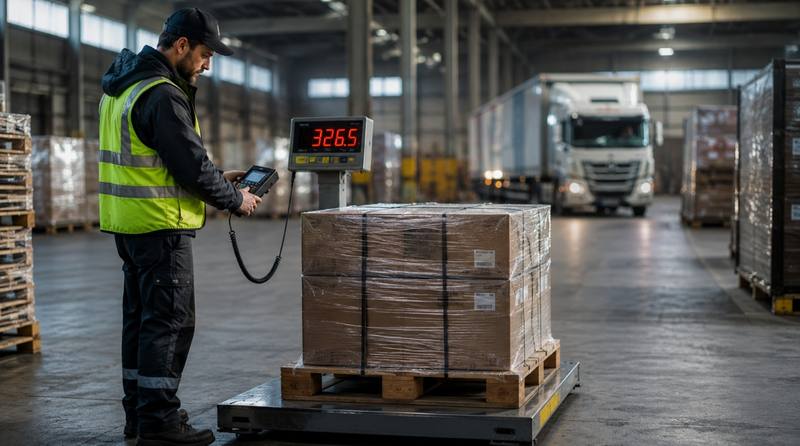
Weight. The actual mass of the shipment together with the packaging.
If the cargo is placed on a pallet, measurements are made after the pallet is fully prepared for transportation.
What is bulk weight?
In many types of transportation, the cost is determined by the greater of two indicators:
- actual weight;
- bulk weight.
This allows you to objectively assess how much space the cargo takes up in the vehicle.
For example, a box weighing only 20 kg, but measuring 120×100×150 cm takes up much more space than a compact load weighing 300 kg. That is why the tariff is calculated taking into account the occupied volume.
For the customer, this means a simple rule: the more accurately the measurements are made, the more accurately the cost of transportation will be calculated.
What mistakes do senders make?
Even experienced shippers sometimes make mistakes when preparing cargo.
The most common of these are:
- Measurement of goods without packaging;
- indication of approximate dimensions;
- lack of information about the pallet;
- incorrect weight after packaging;
- Ignoring protruding design elements.
Each of these errors can lead to a recalculation of the cost or the need to change the terms of transportation after the application.
How Proper Measurements Help Save Money
Accurate cargo information is beneficial to both parties.
For the carrier, this is an opportunity to choose the optimal transport in advance and correctly distribute the space in the body.
For the client, this is:
- absence of hidden surcharges;
- correct calculation of the cost;
- reduction of registration time;
- Minimize the risk of delays;
- safer transportation.
That is why professional logistics companies always recommend paying special attention to cargo preparation.
Proper packaging, reliable fixation and accurate measurements are three simple steps that help avoid most transportation problems.
The more accurately the size and weight of the cargo will be specified, the faster the carrier will be able to calculate the cost of delivery, select the appropriate transport and organize the shipment without additional costs.
A few minutes spent on correct measurements avoid unnecessary costs, delays and misunderstandings at all stages of the logistics chain.