Expert Transportation of dangerous goods in containers through the port and railway: a step-by-step scheme of registration and delivery

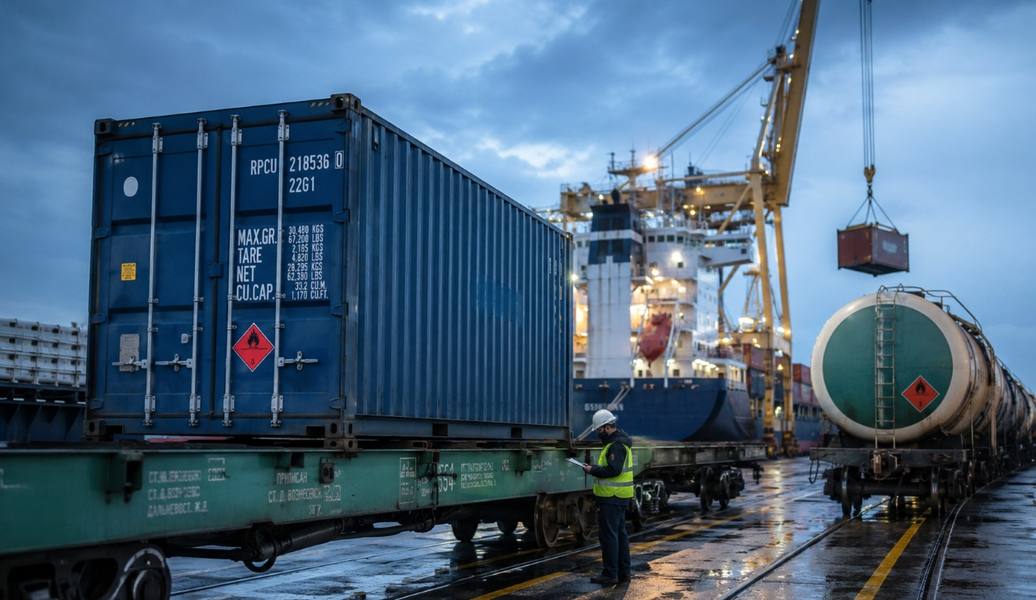
Each container is recorded in the dangerous goods register, indicating the place of storage, the date of receipt and the person responsible.
International Dangerous Goods Logistics remains one of the most complex segments of the transport industry. Unlike conventional container shipping, it is not enough to simply deliver a container from point A to point B. Every operation – from the arrival of the ship to the delivery of the cargo to the final recipient – is governed by international and national safety standards.
Any error in the design of documents, marking or storage organization can lead not only to delays and additional costs, but also to serious fines, a ban on transportation or an emergency situation.
The dangerous goods logistics chain is therefore a multi-step process involving port services, customs authorities, freight forwarders, rail operators, carriers and specialized security services.
Phase one: Preparation before the ship arrives
Work with dangerous goods begins long before the ship enters port.
The main task of transport participants is to confirm the possibility of safe handling of cargo throughout the route.
At this stage, it is determined:
- cargo hazard class;
- UN number (UN Number);
- packing group;
- storage and transportation requirements;
- The need for special permits.
The main international document is the IMDG (International Maritime Dangerous Goods Code).
For cargo, a package of documents is prepared in advance:
- Security Passport (MSDS);
- Dangerous goods declaration;
- invoice;
- packing sheet;
- licenses and permits (if necessary);
- Preliminary customs notifications.
At the same time, the forwarder sends information to the port and container terminal, where the possibility of receiving such cargo is confirmed.
Special attention is paid to the requirements for segregation – the rules for the separate placement of incompatible substances.
For example, acids cannot be stored near combustible materials, and some chemicals require a special temperature regime.
Port call: security first and foremost
After the arrival of the ship, the second stage begins.
The captain, through a ship’s agent, forwards to the port in advance a full list of Dangerous Goods Manifest.
The Port Authority shall verify:
- mooring-place
- availability of special areas for unloading;
- fire-fighting equipment;
- readiness of the terminal for cargo handling.
For dangerous goods, separate sections of the terminal are often used, remote from crowded places and other categories of cargo.
Only after the completion of all inspections, the vessel is accepted and the procedure for unloading containers begins.
Customs clearance: additional level of control
Customs procedures for dangerous goods differ significantly from those for conventional goods.
The package of documents includes:
- goods declaration;
- bill of lading;
- invoice;
- packing sheet;
- Dangerous goods declaration;
- security passport;
- certificates of conformity;
- licenses and permits.
The peculiarity is that customs inspection can be carried out only in compliance with special security measures.
In some cases, specialists in hazardous substances are involved in inspections.
If errors in marking, packaging or documents are detected, the cargo can be detained until the violations are completely eliminated.
For the importer, this means additional storage costs for the container and simple transport.
Unloading and storage at the terminal
After the completion of customs procedures, the container passes into the area of responsibility of the terminal and the stevedoring company.
Unloading of dangerous goods is carried out according to a pre-approved plan.
The main requirements include:
- elimination of mechanical damage to the container;
- Compliance with segregation rules;
- monitoring the integrity of seals;
- check markings.
For storage, specialized sites are used, equipped with:
- fire extinguishing systems;
- emergency means of localization of leaks;
- special markings;
- limited access of staff.
Each container is recorded in the dangerous goods register, indicating the place of storage, the date of receipt and the person responsible.
Expedition inside the port
At the next stage, the forwarder is actively involved in the work.
It provides coordination between the terminal, the carrier and the consignee.
The duties of the forwarder include:
- control of storage periods;
- preparation of documents for further transportation;
- organization of export of the container;
- coordination of the transport scheme.
If the goods are exported by road, it may be necessary to coordinate the route with the regulatory authorities.
The carrier must have access to the transportation of dangerous goods and a set of emergency documentation.
Transfer of the container to the railway
For the majority of imported cargoes coming from the ports of the Far East to the central regions of Russia, the key stage is railway transportation.
Here the rules of Russian Railways and international railway communication begin to apply.
When submitting an application, it is necessary to indicate:
- hazard class;
- UN number;
- the number of containers;
- Special conditions of transportation.
Of particular importance is the choice of rolling stock.
Preferably, specialized fitting platforms approved for the carriage of dangerous goods are used.
Each platform undergoes technical inspection and has appropriate permits.
With a shortage of platforms, alternative transportation schemes are possible, but they require additional approvals and increase the delivery time.

Documents for rail transport
The railway stage is accompanied by a separate set of documents.
The main document is the invoice CM-160.
It must specify:
- hazard class;
- UN number;
- the number of containers;
- a reference to the emergency card;
- type of packaging.
In addition, a declaration for dangerous goods is issued in accordance with the requirements of the SMGS.
Any error in the documentation can lead to refusal to accept the goods for transportation.
The Trans-Siberian Railway and the Eastern Range: the main logistics challenges
Most of the containers with dangerous goods move along the Trans-Siberian Railway.
However, this is where the main logistical difficulties arise.
Among them:
Limited capacity
The number of trains on the Eastern test site is strictly limited.
Dangerous goods do not have priority status, so you can expect to be included in the schedule.
Lack of platforms
Dangerous goods fitting platforms remain a scarce resource.
During periods of high demand, owners of rolling stock significantly increase tariffs.
Additional checks
Each stage is accompanied by a check:
- documents;
- markings;
- container condition.
On average, this increases the processing time by 1-3 days.
Transshipment operations
When using non-standard transportation schemes, containers can be overloaded at intermediate stations.
For dangerous goods, such operations require special sites and additional control.
How much does delivery take?
The terms directly depend on the type of cargo, route and availability of rolling stock.
The averages are as follows:
On specialized fitting platforms
From 14 to 25 days from the moment of departure after customs clearance to arrival in Central Russia.
With complex logistics schemes
25 to 30 days or more.
The most common causes of delay are:
- congestion of terminals;
- Lack of platforms;
- errors in documentation;
- Additional inspections of the supervisory authorities.
Final stage: delivery of goods to the recipient
A final check is carried out upon arrival at the destination station.
The recipient, together with the representatives of the carrier, controls:
- condition of the container;
- Safety of seals;
- availability of markings;
- No damage.
If traces of leakage, deformation or leakage are found, a special act is drawn up with the participation of representatives of the carrier and independent experts.
Only after the completion of all procedures, the goods are considered transferred to the recipient.
Main conclusion
Transportation of dangerous goods in containers is a complex multi-level system where safety becomes a top priority at every stage.
From the correct preparation of documents and coordination with the port to the organization of rail transportation along the Trans-Siberian Railway, each operation requires strict compliance with international and Russian standards.
That is why the successful delivery of dangerous goods depends not only on the availability of a container or transport, but also on the professional work of all participants in the logistics chain. In modern conditions, competent management of such transportation becomes an important competitive advantage for importers, freight forwarders and logistics operators.