Expert AI in agriculture: where farming can already be made more manageable
Implementing AI doesn’t necessarily start with drones, robots and buying new tech
The farm can have good agronomists, modern equipment and several accounting programs.
But the manager can still get the real picture late.
There was a problem at one site. Tech's up. Parts delay. Agronom hasn't checked the field yet. The report of the mechanizer came to the messenger. The data from the technique was preserved separately.
We have information.
But to understand what is happening in the farm, it still needs to be collected.
This is where AI becomes much more interesting than a regular chatbot.
The field can be controlled more precisely.
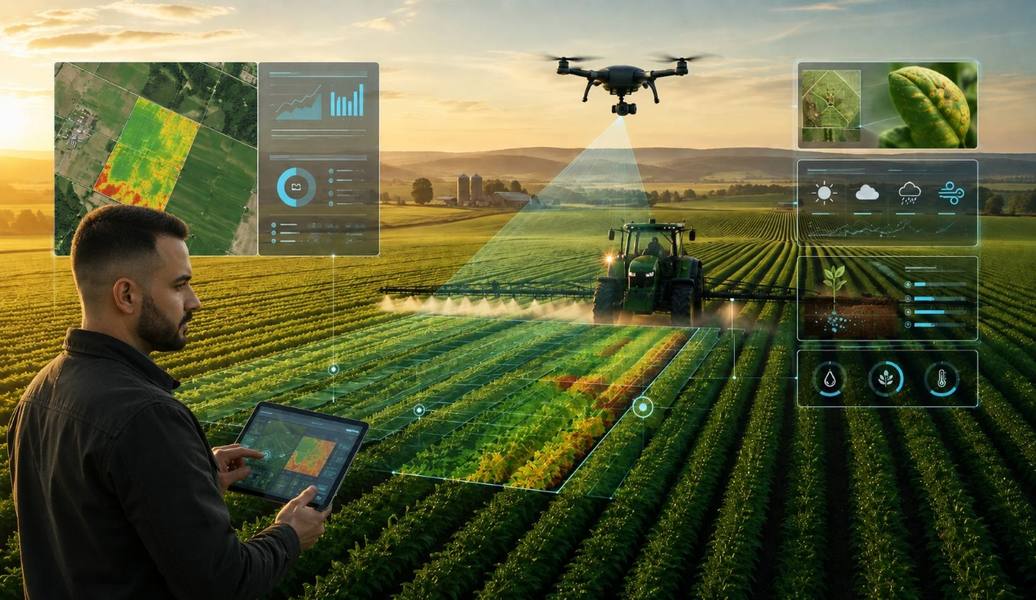
Satellite monitoring allows you to see areas that differ in the state of vegetation, and direct the attention of the agronomist there.
For example, OneSoil and other systems of this class help to work with satellite data and field conditions.
It's not a substitute for examination.
But instead of checking the entire area the specialist gets specific areas that require attention.
If the farm is large, it already affects not only the convenience of work. It's people's time, technique and speed of response to a problem.
The problem can be fixed faster
There are computer vision tools that analyze photos of plants and help pre-identify signs of diseases or pests.
For example, Agrio works with such tasks.
A more useful scenario begins next.
- An employee found a problem at the station.
- I fixed it.
- The information was tied to the field.
- Agronom got the task.
- After the inspection, the result and the actions taken were preserved.
After a while, the farm receives not photos in the phones of employees, but a history of problems in specific areas.
The most underrated site - management
This is where I would look especially carefully.
Because AI adoption doesn’t necessarily start with drones, robots and buying new tech.
The company may already have:
- data
- field-card
- report
- repairs
- spare-parts
- warehouse
- procurement
- plan
- weather data.
The problem is often that it all exists separately.
Now, another option.
The manager opens one report in the morning.
It shows:
- Three sites require inspection
- idle
- No movement on two parts applications
- Part of the planned work is not closed
- In one field, the indicators have changed compared to the previous period.
This is no longer fiction and not one universal AI that manages the economy.
This is normal automation, normal work with data and AI, which helps to collect a clear picture from them.
Employees don’t have to do everything manually either.
The mechanizer needed instructions for a specific technical error.
He can search for a PDF, call an engineer, or write to colleagues.
Or you can ask a question to an internal AI assistant who works with the technical documentation of the farm.
Agronomists send out reports in the evening.
The system can collect them in one summary.
Employees apply for purchase.
AI can structure them by divisions, priorities, and categories.
But here it is important not to confuse a corporate tool with a regular ChatGPT or other neural network.
Internal documents, financial data, information about employees and other closed materials should not be simply uploaded to public neural networks. Such tasks require a separate controlled process with clear access rights.
AI is already working in the field.
There are more serious solutions.
For example, John Deere uses computer vision in the See & Spray system for spotting weeds.
This is another level: cameras, machine learning and agricultural machinery work together.
But I wouldn’t start with the most expensive solution.
First you need to understand where the economy is already losing time and money.
Where to look first
If agronomists spend a lot of time on primary control of large areas, watch satellite monitoring.
If problems on plants are fixed chaoticly, watch computer vision and normal accounting by site.
If the data from the technique are collected, but almost do not affect the decisions, analyze the analytics.
If the manager collects the state of the household from calls, chats and tables, watch the automation of management information.
If employees are constantly looking for instructions, manually making the same reports and transferring data between systems, there is already work for an internal AI assistant.
Where would I start?
I wouldn’t start by asking which neural network to buy.
I would sort out one normal day of business.
What information comes up in the morning.
- Who collects it.
- Where it's stored.
- Who gets it later?
- The manager has to constantly clarify himself.
- What decisions are made too late.
- What actions do employees repeat every day?
After this analysis, it is usually already clear where AI is needed, where conventional automation is enough, and where first you just need to put the process in order.
And then technology begins to solve the problem of business, and not just appears in the farm with another program.