BRICS vs. G7: Where the world economy is headed
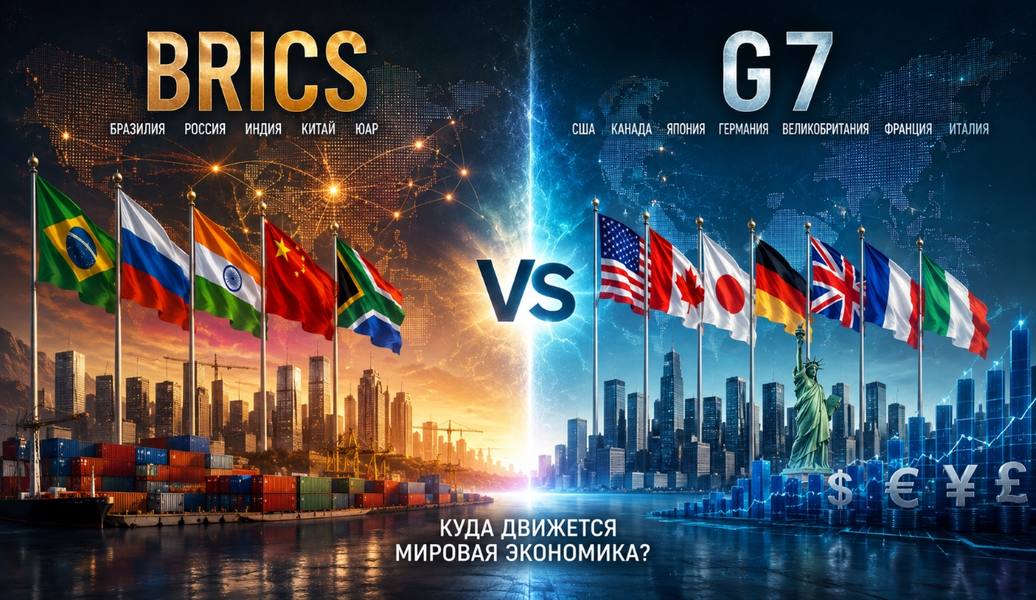
Rather, we are talking about the formation of a new model of the world economy, where several large centers of influence will exist simultaneously.
Ten to fifteen years ago, the global economy seemed predictable. The G7 set the rules for international trade, controlled major financial institutions, set technology trends, and shaped the global investment agenda.
Today, the situation is changing rapidly.
On the world stage, a different alliance is sounding louder. BRICSIt unites the largest developing economies of the world and is gradually turning from a discussion platform into one of the centers of formation of a new economic architecture.
Increasingly, analysts say that the XXI century will be the time of transition from a unipolar world economy to a multipolar one. The confrontation between the two economic models – the G7 and BRICS – will largely determine the development of international business in the coming decades.
Two models of the world economy
Despite the fact that BRICS and G7 are often opposed to each other, these associations differ not only in the composition of participants, but also in the philosophy of development.
G7 It is a union of the world’s largest developed economies:
- United States;
- Canada;
- Germany;
- France;
- Italy;
- Great Britain;
- Japan.
Over the years, these countries have shaped the rules of world trade, financial markets, the banking system and international lending.
BRICS The largest emerging economies are:
- Brazil;
- Russia;
- India;
- China;
- South Africa,
New countries that have joined in recent years.
The main feature of BRICS is that the participants rely on the development of industry, mutual trade, infrastructure and investment cooperation without a strict link to Western financial institutions.
Why the BRICS influence is growing
The main reason is simple: the scale of the global economy has changed.
Whereas the bulk of world production used to be in Europe and North America, today the center of industrial growth is gradually shifting to Asia.
This is where the focus is:
- the largest production capacity;
- the main supply chains;
- new technologies of industrial production;
- fast-growing domestic markets.
China’s role is particularly prominent.
In recent decades, the country has become not just a “global factory”, but a major exporter, investor and producer of high-tech products.
Together with India, China is becoming one of the key drivers of global economic growth.
The economy is already talking numbers
Economists are increasingly paying attention not to political statements, but to real indicators.
Today, the BRICS countries:
- produce a significant part of the world's industrial volume;
- provide a significant share of global economic growth;
- have huge reserves of natural resources;
- It is one of the largest consumer markets in the world.
At the same time, the population of the BRICS countries significantly exceeds the population of the G7 countries.
This means that this is where the future demand for goods, technology, infrastructure and services is concentrated.
BRICS bets on investment
Previously, cooperation within the association was limited to political meetings, but today real economic projects are actively developing.
Priority areas:
- construction of transport corridors;
- development of industrial cooperation;
- creation of joint productions;
- the digital economy;
- energy;
- agriculture;
- logistics;
- Artificial intelligence.
More and more attention is paid to mutual investments.
New development funds, financial mechanisms and programs to support international projects are emerging.
Dedollarization - myth or reality?
One of the most discussed issues in recent years is the gradual refusal of a number of countries to use the dollar in mutual trade.
This is not about the complete disappearance of the US currency.
However, many countries are trying to reduce their dependence on a single payment system.
Today we are increasingly using:
- settlements in national currencies;
- bilateral clearing schemes;
- regional payment systems;
- Digital currencies of central banks.
This process is developing gradually, but it has the potential to seriously change the international financial system in the coming years.
China becomes Asia’s investment hub
China holds a special place.
Today, the country is actively investing in infrastructure, industry, logistics and high technology around the world.
Initiatives to develop transport corridors, create new industrial parks and expand international investment sites make China one of the world’s largest centers of capital attraction.
For many companies, participating in Chinese trade fairs, investment forums, and B2B talks is the first step to entering the international market.
What it means for business
The global economy is gradually becoming less centralized.
This opens up new opportunities for entrepreneurs.
Today, it is no longer enough to focus only on European or American markets.
More and more companies are considering:
- China;
- India;
- countries of the Persian Gulf;
- States of Southeast Asia;
- Africa;
- Latin America.
This is where new consumers, investors and production sites emerge.
Who will benefit from the new world economy?
The winners will not be the largest companies, but the most flexible ones.
Those who learn to work in several markets.
Those who can quickly rebuild the logistics.
Those who understand the specifics of international negotiations.
Those who build partnerships with producers and investors from new economic centers.
In the modern world, the competitive advantage is not only the price of the product, but also the speed of decision-making, access to international markets and the ability to adapt to changes.
The world is not divided into winners and losers.
The confrontation between the BRICS and the G7 does not necessarily mean that one side will win.
Rather, we are talking about the formation of a new model of the world economy, where several major centers of influence will exist simultaneously.
For business, this means one thing: more opportunities, but more competition.
Companies that are already starting to explore new markets, building international ties and investing in the development of export destinations get a serious advantage.
The future of the global economy will be determined not by political slogans, but by the ability of states and companies to create new technologies, develop production, build logistics and find mutually beneficial forms of cooperation.
That is why the confrontation between the BRICS and the G7 is not a struggle for leadership, but the beginning of a new era of the global economy, in which success will belong to those who will be able to see opportunities before others.