How to stop depending on a single buyer
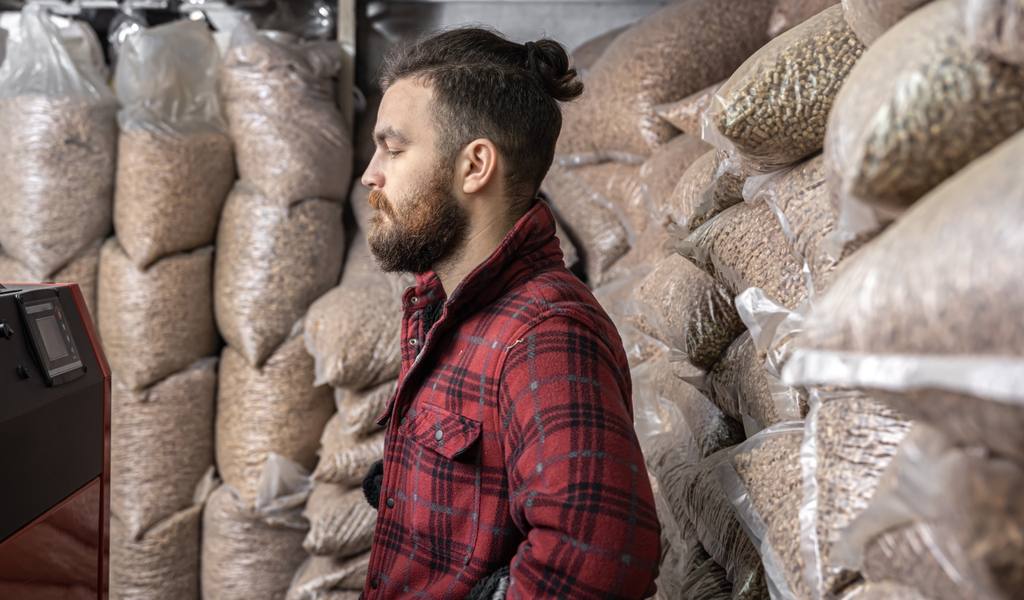
Imagine a farm that sells almost the entire volume to one processor.
One big buyer is convenient.
He regularly picks up products, the requirements are clear, there is a history of work, there is no need to constantly look for new customers. But at some point, convenience turns into addiction.
The buyer begins to reduce the purchase price. Changing payment terms. Reduces volume. Receiving acceptance. Or simply reject the next party.
And then the manufacturer understands the unpleasant thing: The problem is not that one customer has disappeared. The problem is that there were no other buyers in advance.
For an agricultural producer, sustainability today increasingly depends not only on yield and cost, but also on the ability to work with several channels at once. This trend is relevant for the Russian agro-industrial complex: the state continues to develop sales infrastructure, cooperation and export directions.
Why is there one buyer? - It's a risk.
Imagine a farm that sells almost the entire volume to one processor.
As long as the relationship is good, the model works.
But if the buyer:
- reduced the purchase price;
- reduced the volume of procurement;
- increased the delay of payment;
- changes in quality requirements;
- stopped production;
- found another supplier,
The manufacturer has a product that needs to be sold immediately.
An urgent sale almost always means a weak bargaining position.
When you have one customer - You depend on his decision. When you have multiple channels - You can choose.
The first step is to calculate the real dependency.
Many businesses think they have multiple buyers.
But if one customer provides 70-80% of revenue, the rest of the contacts do not change the situation.
Do a simple analysis:
Who buys your products?
Make a list of all customers in the last 12 months.
How much is everyone buying?
Calculate not only the number of tons or units of production, but also the share in the total revenue.
What happens if the biggest customer disappears?
If the answer is “we have to urgently look for sales”, then the dependence is already high.
The main task is not necessarily to abandon a large buyer. You have to stop being totally dependent on him.
The second step is to divide products between multiple channels.
Don’t try to replace one big customer with ten random customers.
It's much more efficient to build a system.
For example:
40% - Big regular buyer.
25% - processors.
15% - regional wholesalers.
10% - retail chains or HoReCa.
10% - New directions and exports.
This is just an example. Each product will have its own structure.
For grains, vegetables, dairy products, meat or processed foods, the channels will be different.
The main rule:
No buyer should be the only point through which all your revenue flows.
The third step is to look not just for buyers, but for different types of buyers.
One of the manufacturers’ mistakes is to look for “another customer.”
But the market is wider.
Depending on the product, potential channels may include:
- processing enterprises;
- trade networks;
- regional distributors;
- wholesalers;
- HoReCa businesses;
- food production;
- feed mills;
- other agricultural producers;
- export companies;
- end users;
- agroaggregators;
- Electronic and specialized B2B platforms.
In Russia, the infrastructure of agro-aggregators is developing, which should help producers consolidate and supply farm products to retail networks.
The fourth step is to stop selling just “goods.”
Customers rarely need an abstract product.
He needs a party with specific characteristics.
For example, for one buyer is important:
- volume;
- stable supply;
- low price.
For another:
- a certain grade;
- humidity
- protein content;
- caliber;
- origin;
- packaging;
- regularity.
The same product may have different value for different customers.
Therefore, the manufacturer needs to form product passport:
- What do you produce?
- to what extent;
- What characteristics do you guarantee?
- What documents are available;
- where the production is located;
- What geography of delivery can be provided;
- In what format do you sell your products?
This makes it much easier to find new customers.
The fifth step is to build a customer base before a problem arises.
A new customer does not appear in one day.
Especially in agriculture where:
- quality;
- stability;
- supply history;
- documents;
- samples;
- production opportunities.
Therefore, the search for buyers must go constantly.
Even if today the whole volume is successfully sold.
Create a base:
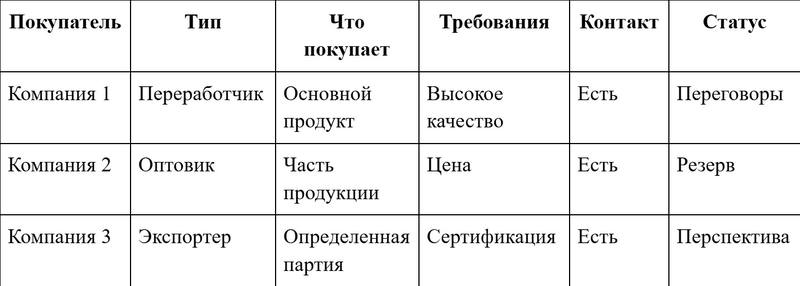
The main thing is to regularly update this database.
At the moment when the main buyer has reduced the volume of purchases, it is too late to look for contacts.
Step Six: Learn to Sell Directly
Many manufacturers have been working through an intermediary for years simply because it’s easier.
But the middleman often knows the end market better than the manufacturer.
He understands:
- who buys;
- what volumes are needed;
- What prices exist;
- where there is a shortage;
- What are the requirements of different customers?
Some of this knowledge the manufacturer needs to gradually recover.
It is not necessary to completely abandon intermediaries.
It is better to build a model:
piece - through trusted partners, part of - through direct sales.
This gives the manufacturer information about the real market and improves the negotiating position.
Step Seven: Think about recycling
The most difficult way is to sell only raw materials.
The more a product differs from a standard mass product, the more opportunities there are to work with different customers.
For example:
Grain → sorting → processing → packaged product.
Milk → processing → finished products.
Vegetables → sorting → packaging → retail supplies.
Of course, recycling requires investment.
But even minimal product refinement can open up new sales channels.
For example:
- sorting;
- calibration;
- packaging;
- packaging;
- cooling;
- storage;
- Preparation of products to the requirements of a specific customer.
The Eighth Step: Use Cooperation
For small farms, the problem is often not the quality of the product, but the volume.
The customer needs regular delivery.
A single farm can produce a good commodity, but it does not provide the necessary volume all year round.
Cooperation can help here.
The association of producers allows:
- forming large parties;
- joint use of warehouses;
- Reduce logistics costs;
- purchase of equipment;
- organize processing;
- to reach out to larger buyers.
In 2026, the Ministry of Agriculture continues to support agricultural cooperation, with increasing attention to joint cost reduction and infrastructure development.
Step Nine: Treating exports as a complementary channel
Exports are not suitable for every farm.
But even if the manufacturer is not yet ready to work independently with foreign buyers, you can start by exploring the possibilities.
Options:
- Sales to exporters;
- participation in export associations;
- work through traders;
- cooperation with other manufacturers;
- Preparation of products to meet the requirements of a particular market.
Russia continues to expand the geography of agricultural exports, and government agencies are developing support for companies entering foreign markets.
The goal is not to start exporting immediately.
Purpose - Add another potential market.
How to build a system in 90 days
First 30 days
Perform an audit:
- buyers;
- volumes;
- revenue;
- marginality;
- depending on the largest customer.
Identify the products that are easiest to sell to new customers.
Next 30 days
Form:
- commercial offer;
- product passport;
- the base of potential buyers;
- List of requirements of different channels.
Start the first negotiations.
The last 30 days
Run test deliveries.
Even a small new customer is important.
Your task is to check:
- the real price;
- requirements;
- logistics;
- documents;
- due date.
After that, you can scale the working channels.
Main conclusion
Dependence on one buyer rarely occurs in a day.
It forms gradually.
At first, a large customer seems comfortable. Then the production begins to focus on it. Then the entire company is rebuilt under its requirements.
And one day it turns out that the buyer controls not only the purchase, but also the future of the manufacturer.
Therefore, the right strategy is not to look for a new buyer only after losing the old one.
You need to build a system in advance that has:
several customers + different sales channels + base of potential buyers + understandable product + alternative markets.
The buyer remains an important partner.
But you are no longer the only person who decides whether your business will have revenue tomorrow.