The most promising agricultural technologies: what solutions will change agriculture in the coming years
If earlier the competitive advantage was determined by the amount of land and machinery, today technology is becoming increasingly important.
Modern agriculture is undergoing one of the largest technological transformations in recent decades. Global population growth, climate change, labor shortages, rising resource costs and increasing product quality requirements make farmers look for new ways to improve efficiency.
If earlier the competitive advantage was determined by the amount of land and machinery, today technology is becoming increasingly important.
Agricultural technologies are becoming the main factor that allows you to get a higher yield, reduce costs and reduce risks.
We will discuss what solutions are changing the industry and what technologies will become the basis of agriculture in the coming years.
Precision agriculture
Until a few years ago, most fields were treated the same way.
Things are changing today.
Each piece of land has its own characteristics:
- soil composition;
- humidity level;
- nutrient content;
- yields of past years;
- degree of weed contamination.
Modern precision farming systems allow you to take into account all these parameters and make decisions on literally every square meter of the field.
As a result, the farmer has the opportunity to:
- reduce fertilizer consumption;
- reduce the use of plant protection products;
- increase yields;
- reduce the cost of production.
Almost all large agricultural holdings already use elements of precision farming.
Unmanned agricultural machinery
Automation is gradually coming not only to factories, but also to the fields.
Modern tractors, harvesters and sprayers are able to perform many operations almost without human intervention.
Used:
- GPS navigation;
- Autopilots;
- traffic control systems;
- automatic disabling of sections;
- digital field maps.
This significantly reduces the number of errors in the operation of the equipment.
Such solutions are especially relevant in the context of a shortage of qualified mechanics.
Drones in agriculture
Until recently, drones were used mainly for shooting.
Today, they have become a full-fledged working tool of farmers.
Drones allow:
- survey the fields;
- identify plant diseases;
- determine the lack of moisture;
- control the development of cultures;
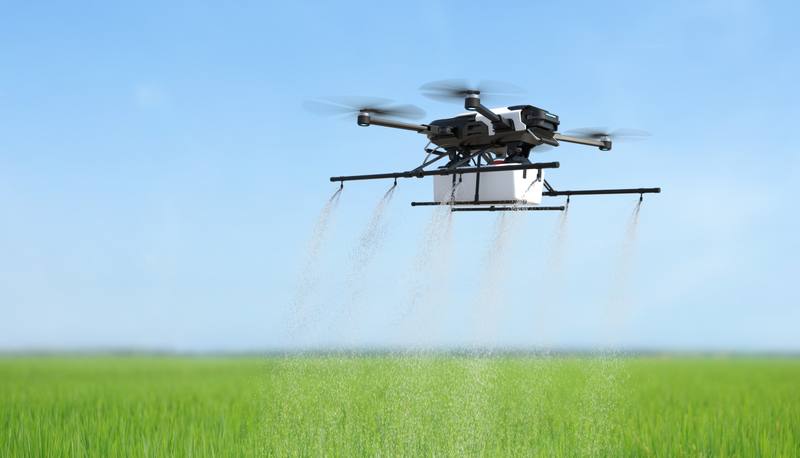
- conduct point application of plant protection products;
- Create digital crop maps.
Such technologies are especially in demand in large areas where visual control is practically impossible.
Robotization of livestock
Modern livestock complexes are increasingly becoming similar to high-tech enterprises.
Many farms already use:
- robotic milking systems;
- automatic feed stations;
- animal health control systems;
- electronic tags;
- automatic monitoring of activity.
Each animal actually gets its own digital status card.
At the first signs of the disease, the system is able to inform the operator even before obvious symptoms appear.
This significantly reduces losses and increases the productivity of the herd.
Digital management platforms
Modern agriculture is gradually becoming digital.
Today, the manager can see almost all the work of the enterprise in one interface.
Digital systems combine:
- technique;
- warehouses;
- fields;
- personnel;
- procurement;
- sales;
- logistics;
- financial performance.
This allows you to make management decisions much faster.
In fact, the agricultural enterprise is turning into a single digital ecosystem.
Smart irrigation
Climate change makes water a key issue for agriculture.
Modern watering systems no longer work on a fixed schedule.
They take into account:
- soil moisture;
- air temperature;
- weather forecast;
- the phase of plant development;
- The need for a specific culture.
Water is provided only when it is needed.
This allows you to save significant amounts of resources and at the same time increase yields.
Biotechnology
Another rapidly developing area is the use of biological solutions instead of traditional chemistry.
Increasingly, there are:
- biological means of plant protection;
- microbiological fertilizers;
- preparations for soil restoration;
- growth promoters;
- biofungicides.
Such technologies can improve soil condition, reduce chemical load and increase plant resistance to stress.
Modern selection
Changing weather conditions require the emergence of new varieties and hybrids.
Today, breeding is aimed at creating cultures that:
- better tolerate drought;
- resistant to disease;
- withstand temperature changes;
- use moisture more efficiently;
- They have a higher yield.
It is modern varieties that are becoming one of the most important factors in the growth of agricultural efficiency.
Automation of grain storage
A high harvest does not guarantee a profit.
It is important to preserve products without loss of quality.
Modern granaries are equipped with:
- Temperature control systems;
- humidity sensors;
- automatic ventilation;
- digital monitoring;
- remote control.
This significantly reduces storage losses and preserves the commodity characteristics of grain.
New processing technologies
More and more companies are moving from selling raw materials to producing products with high added value.
Deep processing technologies are developing:
- grains;
- oilseeds;
- soy
- corn;
- peas;
- rape.
The higher the degree of processing of products, the higher the potential profit of the enterprise and less dependence on fluctuations in commodity markets.
Internet of Things (IoT)
Hundreds of sensors are already able to monitor the work of the farm around the clock.
They measure:
- temperature;
- humidity
- state of the art;
- fuel consumption;
- level of filling of silos;
- operation of equipment;
- Product storage parameters.
All information comes in real time.
This allows you to quickly respond to any deviations and prevent serious losses.
Environmental technologies
Consumers and foreign markets are increasingly demanding environmental performance.
Therefore, there is growing interest in technologies that allow:
- reduce carbon emissions;
- conserve water;
- reduce the use of chemicals;
- preserve soil fertility;
- Recycling production waste.
In many countries, such technologies are already becoming a mandatory element of modern agricultural policy.
Why is the technological revolution starting now?
The development of agricultural technologies is associated with several global factors.
Agriculture faces major challenges:
- climate change;
- increasing the cost of resources;
- shortage of personnel;
- Increasing global demand for food;
- the need to improve production efficiency.
Therefore, the introduction of new technologies ceases to be a matter of prestige and becomes a prerequisite for maintaining competitiveness.
What will agribusiness do in five years?
Experts agree that the market leaders will be enterprises that can effectively combine modern technologies with competent management.
The future of the industry is not one universal innovation, but an integrated approach, where digitalization, automation, modern varieties, efficient logistics and rational use of resources work as a single system.
Those farms that are already beginning to introduce promising agricultural technologies are able not only to reduce costs, but also to significantly increase the sustainability of business in a constantly changing market.
Conclusion
The agro-industrial complex is rapidly turning into one of the most technologically advanced sectors of the economy. Robotics, precision farming, digital platforms, storage automation, modern processing and biotechnology are no longer the technologies of the future – they are becoming the standard for efficient agriculture.
Competition in the industry will increasingly depend not only on the area of land or the volume of equipment, but also on how quickly the enterprise implements modern solutions. Technology will be the main source of growth in productivity, sustainability and profitability of agribusiness in the coming years.