How to choose suppliers of equipment for agribusiness: a step-by-step guide
A good supplier can usually name markets, customer types, and export volumes.
Choosing a supplier of equipment for agribusiness is not just about finding the lowest price. An error at this stage can turn into a disrupted season, downtime of equipment, problems with spare parts and additional costs.
This is especially true when purchasing equipment in China: there are many manufacturers, offers are similar, and it is difficult to distinguish a real plant from a trading company.
Therefore, it is better to choose a supplier not “according to sensations”, but according to an understandable algorithm.
Step 1. First, determine what exactly you need.
Don’t start your search with the words “find a factory.”
First, make a technical task.
It shall contain:
- purpose of equipment;
- productivity;
- power;
- dimensions;
- operating conditions;
- the required equipment;
- requirements for automation;
- climatic conditions;
- standards and certification;
- the desired budget;
- Estimated purchase volume.
For example, instead of asking, “I need a tractor.”
It is better to formulate: “Tractor 100-120 hp, all-wheel drive, three-point hanging, certain load capacity, work at low temperatures, delivery to Russia”.
The more accurate the task, the fewer inappropriate offers you will receive.
Step 2. Look not for one supplier, but at least 5-10.
Never make a decision on the first good offer.
Optimally assemble 5-10 potential producersand then reduce the list to 3-5 companies.
It's not just the price that needs to be compared.
Create a table and enter:
Criteria
- Price.
- MOQ
- Term of production
- Guarantee
- Spare parts.
- Service
- Certificates
- Export experience
- OEM
Such a table quickly shows where the really profitable offer, and where just an attractive price.
Step 3. Check: Is it a factory or a middleman?
One of the most common mistakes is to mistake a trading company for a manufacturer.
A Chinese supplier can have a beautiful website, a catalogue of several hundred models and photos of a huge enterprise, but do not produce anything.
Ask:
- full legal name of the company;
- Business License;
- address of production;
- photos and videos of workshops;
- list of equipment;
- number of employees;
- list of own models;
- export documents;
- spare parts catalogue.
And most importantly, Make a video call directly from the factory..
Ask the manager to show the production line, warehouse and finished products in real time.
Step 4. Look who is already buying from this supplier.
Export experience is one of the best indicators of a company’s maturity.
Ask:
- Which countries do you ship to?
- How many years have you been exporting?
- Are there dealers?
- What is the supply?
- Are there any clients in Russia or CIS?
If a company says, “We work with the world,” ask for specifics.
A good supplier can usually name markets, customer types, and export volumes.
Step 5. Check documents and certificates
Having a certificate on the site does not guarantee anything.
Ask for documents specifically for modelThe one you're going to buy.
Check it out.
- producer;
- document number;
- expiration date;
- model of equipment;
- scope of application;
- compliance with the requirements of the Russian market.
Especially carefully check the equipment with engines, electronics, automation systems and other complex equipment.
Step 6. Compare not the price, but the final cost.
The price of the plant is only one part of the cost.
To the cost of equipment can be added:
production → delivery in China → export clearance → transportation → insurance → customs payments → certification → delivery in Russia → installation → launch.
So instead of asking, "How much does the equipment cost?"
Better ask: How much will the equipment cost in my warehouse in Russia?
This figure allows you to compare suppliers normally.
Step 7. Check the service separately
This is critical for agribusiness.
Before ordering, ask:
- where the nearest service center is located;
- Who will repair the equipment;
- How much does it cost to leave the engineer;
- How long does the diagnosis take?
- What spare parts are in the warehouse;
- How long to wait for rare details;
- Is there technical support in Russian?
- How the service works in season.
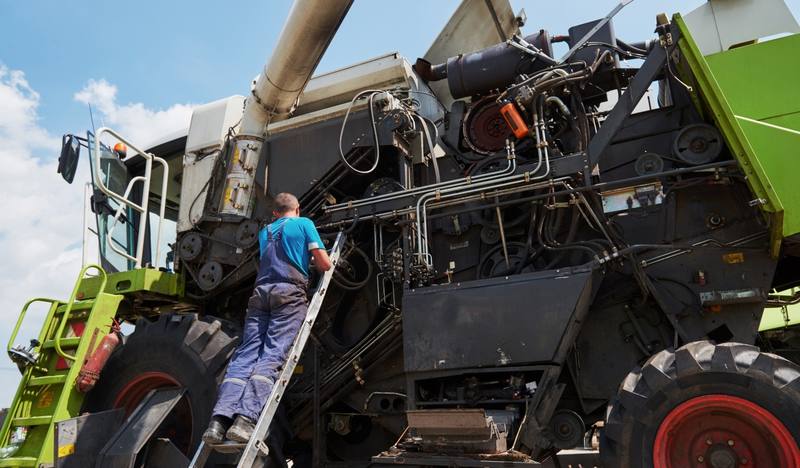
If a supplier sells an expensive harvester but can’t explain where to get a belt, sensor or hydraulic component two years from now, that’s a serious reason to think.
Step 8. Order a sample or test unit
If the equipment is expensive, do not immediately buy a large batch.
It is better to go through several stages:
sample → testing → adjustment → small batch → scaling.
This is especially important for OEM projects.
Spending money on one test machine is much cheaper than detecting a problem after delivering 20 units.
Step 9. Conduct an inspection before sending
Even if the supplier has passed all the checks, it is worth conducting an inspection before shipment.
Checking:
- quantity;
- completeness;
- serial numbers;
- appearance;
- operability;
- packaging;
- marking;
- documentation;
- spare parts.
For a large batch, a pre-shipment inspection is a relatively small expense item that can protect against much more serious problems.
Step 10. Properly execute the contract
Do not limit yourself to account and correspondence on WeChat.
The contract shall specify as specifically as possible:
- model;
- configuration;
- technical specifications;
- price;
- deadlines;
- terms of payment;
- terms of delivery;
- packaging;
- guarantee;
- fines;
- the procedure for complaints;
- liability for delay;
- set of spare parts;
- documentation requirements.
The more detailed the configuration is prescribed, the less opportunities for discrepancies.
Step 11. Don’t give 100% of your money in advance
For a large order, it is safer to use a phased payment.
For example:
advance → production → inspection → residual payment → shipment.
The specific scheme depends on the supplier, the amount and the terms of the transaction.
The basic idea is simple: don’t pay for expensive equipment in full before you’ve made sure it’s actually made and fits the order.
Step 12. Evaluate the supplier by 7 main criteria
If you need to make a decision quickly, use a simple checklist.
- Production Does the company really make the equipment?
- Quality. Is there quality control and clear characteristics?
- Price. How competitive is the offer?
- Logistics Can the supplier organize the export?
- Service What happens after the sale?
- Spare parts. How easy is it to maintain the equipment?
- Reliability How long has the company been operating and who are its customers?
If a supplier only wins on one point – a low price – it is not a good supplier.
The main principle here is simple: Don’t choose a supplier who just sells equipment. Choose a partner who can support it after the sale.
For agribusiness, this is especially important: a good supplier earns with the customer for years, and a bad one finishes the job the moment the container leaves the factory.